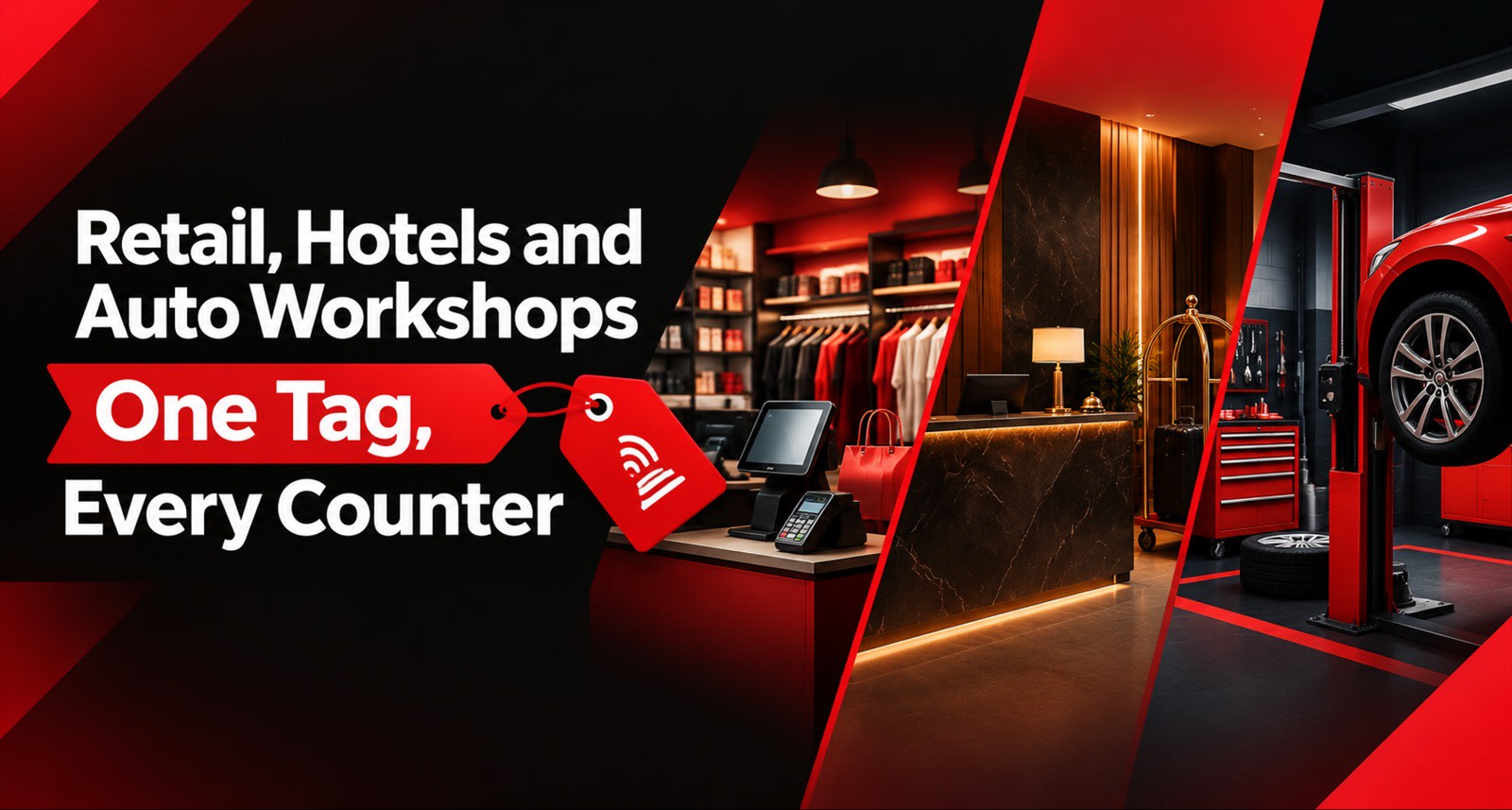
Walk into a clothing store, a hotel lobby and a car service centre on the same afternoon and you'd struggle to find three businesses with less in common.
One sells objects in five minutes. One sells a two-night stay. One sells work you can't see, on a machine you depend on, at a price you were nervous about.
And yet all three have exactly the same review problem, and the same fix. Each has one specific moment where the customer is finished, satisfied and momentarily still and in all three, that moment usually passes with nobody saying anything.
This is where that moment sits in each business, and what to put there.
The Thing All Three Have in Common
Every business that serves customers in person has what you could call a completion pause. The transaction is done, the customer hasn't left yet, and for ten to sixty seconds they have nothing to do.
Business | The completion pause |
Retail | Waiting for the card machine or the bag |
Hotel | Settling the bill at check-out |
Auto workshop | Listening to what was done before taking the keys |
That pause is the only reliable window you get. Before it, the customer is still transacting. After it, they're gone and the moment has cooled.
A google review card for business use exists to occupy that pause so the ask lands while the customer is already standing there, rather than relying on them remembering you six hours later. The underlying failure, across every sector, is in Why Happy Customers Don't Leave Google Reviews.
What changes between these three businesses isn't the mechanism. It's where the pause happens, how long it lasts, and what the review needs to say.
Retail Stores
The problem: speed
Retail has the shortest pause of the three. A customer at a till is there for forty seconds, often less, and half their attention is on their bag, their card, or the queue behind them.
That's why retail review rates are usually poor despite enormous footfall. A clothing store serving 300 customers a week might collect four reviews a month not because customers were unhappy, but because nobody was ever not-in-a-hurry.
Where the tag goes
Position | Why |
Beside the card machine | The customer's eyes are already there during payment |
At the bagging point | A second natural pause while items are packed |
Not behind the counter | If staff must hand it over, staff will forget |
The card-machine position is the single highest-converting spot in retail. The customer is looking down at a terminal for twenty seconds with nothing else to do, and a stand sitting beside it enters their field of view without anyone having to say a word.
The general case for counter placement is covered in Google Review Stand for the Billing Counter: Placement That Converts.
What retail reviews should mention
Retail reviews are usually the thinnest of any sector "good shop, nice collection" which ranks for nothing.
What actually helps:
Product category "good range of ethnic wear," "genuine electronics," "wide shoe sizes"
Staff helpfulness the single biggest differentiator between a shop people return to and one they don't
Exchange and return experience a top-three anxiety for retail shoppers
Billing speed ironically, people review fast checkouts
Configure those as your tappable options and keywords rather than generic terms. The setup is in Create a Review Questionnaire Quickly and Easily.
The retail-specific trap
Multi-till stores using one shared code. A store with four tills and one code can't tell you which counter, which shift, or which staff grouping is actually generating reviews. Give each till its own code it costs nothing and it turns a flat number into a staffing insight. The approach is in QR Code Management: One Code Per Table, Counter or Campaign.
The line that works at a till
"If you found what you needed, just tap here takes twenty seconds."
Short, because you have no time. Conditional, so there's no pressure.
Hotels
The problem: the review already has somewhere else to go
Hotels are the only one of these three where guests have an established reviewing habit and it mostly points at OTAs and travel sites, not Google.
Which is a problem, because Google is where someone searching "hotels in Vijayawada" on their phone actually lands. OTA reviews help your listing on that platform. Google reviews help you get found at all.
The second problem: the pause is long but distracted
Check-out gives you a genuinely generous window of two or three minutes while the bill is settled. But the guest is simultaneously managing luggage, a cab, a flight time and a companion. Longer doesn't automatically mean better.
Where the tags go
Hotels need more placements than retail, because guests touch several points:
Location | Format | Catches |
Reception / check-out desk | Counter stand | Primary everyone passes |
In-room | Small desk tag or card | Guests in a calm moment, often the evening |
Restaurant or café | Table tent | Separate experience, often separate listing |
Concierge / bell desk | Staff card | Guests who skip the desk on express check-out |
The in-room placement is the one hotels most often skip and the one with the most upside. A guest sitting in their room after a good first night is relaxed and unhurried in a way a departing guest never is and that's when the warmest reviews get written.
A multi-outlet complication worth getting right
Hotels frequently run several Google listings of the hotel, the restaurant, sometimes the spa or banquet hall. Point each placement at the correct listing. A restaurant review landing on the hotel listing helps neither.
Separate codes per outlet solve this cleanly, and because the destination behind a code is editable from the dashboard, you can correct a mis-pointed placement without reprinting anything.
What hotel reviews should mention
Room cleanliness the top decision factor, every time
Staff courtesy named staff, ideally
Breakfast disproportionately influential in Indian hotel reviews
Location and accessibility "close to the station," "easy parking"
Check-in speed a known pain point, so praise carries weight
Use a measured, warm tone rather than a casual one: hotel guests reading reviews are making a bigger commitment than someone picking a café, and the register should reflect that. Tone settings are covered in AI Tone Selection: Getting Reviews That Sound Like Your Real Customers.
The line that works at check-out
"Hope you enjoyed your stay. If you'd like to share it on Google, you can just tap here and it takes about twenty seconds."
Naming Google matters here specifically, because guests default to assuming any review request means the booking platform.
🔧 Auto Workshops
The problem: the best moment is also the most fragile
Auto service has, arguably, the strongest emotional moment of the three and the highest stakes attached to it.
A customer collecting their vehicle has spent a day without it, paid an amount they were anxious about, and is now hearing what was done. If the explanation is clear and the bill matches the estimate, the relief is substantial. That relief is the best review fuel in this entire article.
But it's fragile. If the bill came in higher than quoted, or the explanation was vague, the same moment produces the opposite. Auto workshops have unusually polarised review profiles for exactly this reason.
Where the tag goes
The handover is not at a counter, it happens at the vehicle, or standing at the service desk with the job card. So the hardware has to move:
Position | Format | Why |
Service advisor's pocket | Google review business card | The handover happens wherever the car is |
Billing desk | Counter stand | Backup for customers who pay first |
With the invoice | Card tucked into the job card folder | Travels home with the customer |
Pickup/drop teams | Keychain tag | Doorstep handover, no premises visit at all |
This is the sector where staff-carried cards matter most, because the handover is mobile by nature. The reasoning is in Google Review Business Cards for Staff: Turning Every Handoff Into a Review. For doorstep pickup and drop teams specifically, Google Review Keychain: The Review Tool for On-the-Go Teams covers the format.
What auto reviews should mention
Auto customers read reviews looking for one thing above all: whether they'll be cheated.
So the highest-value review content is:
Honest pricing "charged exactly what was quoted" is the most persuasive sentence in the sector
Clear explanation "showed me the old parts," "explained what needed doing and what could wait"
Turnaround time "ready same day"
Genuine parts a major anxiety
No upselling "didn't push unnecessary work"
Notice how different these are from retail or hotel reviews. Auto reviews are trust documents, not satisfaction notes. Configure your keywords accordingly the method is in Keyword Configuration: Making Every AI Review Work for Your Google Ranking.
The line that works at handover
"Everything's sorted, here's what we did. If the service works for you, a quick tap here helps us a lot."
Deliver it after the explanation, never before. The explanation is what earns the ask.
Where Unhappy Customers Go and Why It Differs by Sector
All three businesses benefit from the rating-first split, but for different reasons.
Sector | Typical complaint | Why catching it privately matters |
Retail | Exchange refused, staff manner | Usually resolvable on the spot with a manager |
Hotel | Room issue, noise, billing | Often fixable during the stay if heard early |
Auto | Bill exceeded estimate, issue not fixed | Highest escalation risk; most damaging public reviews |
The hotel case is the most striking. A guest who reports a problem on night one can be moved, compensated or apologised to and frequently leaves happy. The same guest posting on day three has already left, and you've lost both the review and the guest.
Auto workshops see the most damaging public complaints of the three, because disputes about money and trust produce long, detailed, furious reviews that prospective customers read carefully.
In all three cases the limit is the same: nobody is blocked from posting publicly, and nobody should be. What changes is who hears first. Running that queue properly is covered in From Feedback to Fixes: Using the Private Feedback Dashboard.
One System, Different Settings
Here's the practical payoff of the shared mechanism: if you operate more than one of these a hotel with a retail outlet, a dealership with a service centre, a chain with several formats you run one platform and simply configure each differently.
Setting | Retail | Hotel | Auto |
Primary placement | Till counter | Reception + in-room | Service advisor's card |
Tone | Friendly | Warm, measured | Friendly, practical |
Key terms | Product range, staff, exchange | Cleanliness, breakfast, location | Honest pricing, turnaround, genuine parts |
Secondary placement | Bagging point | Restaurant, concierge | Billing desk, invoice folder |
Separate codes | Per till | Per outlet | Per advisor or bay |
Same hardware family. Same dashboard. Same customer experience tap or scan, no app, no login, which matters equally to a hurried shopper, a departing guest and someone standing beside their car.
That flow is explained in Simple Tap or Scan: How ReviewTAG Works Without Any App Download.
The Three Rules That Apply Everywhere
Whichever counter you're standing at:
1. Never ask for a rating. "Please share your experience" is an offer. "Please give us five stars" is a demand, and it crosses a line that matters.
2. Never offer anything in exchange. No discount, no free service, no upgrade, no loyalty points. This is the most common reason honest businesses get their listings penalised, and one enthusiastic staff member can create the problem without meaning to. The boundaries are in the Terms & Conditions.
3. Ask once. Once is an offer. Twice is pressure, and pressure produces either a bad review or no review.
Measuring Across Different Formats
Multi-format operators should resist the urge to look at a single blended number. A hotel group's combined 4.3 across hotel, restaurant and spa tells you almost nothing; segmented, it might be 4.6, 4.5 & 3.4 and you'd finally know where to look.
What to review monthly:
Velocity per code any code at zero means a physical problem, not a demand problem
Rating spread by outlet averages hide the thing you need to find
Response rate every negative review answered, roughly a third of positives
Trend since the last change did the new placement actually work?
Fifteen minutes a month. The framework is in Review Analytics That Matter: Reviews, Ratings, Responses and Trends.
Explore the ReviewTAG Collection with Dynamic QR Codes →
Create Your ReviewTAG Business Account — Sign Up Now →
Talk to Our Team on WhatsApp for a Free Setup Demo
FAQs
Can one account cover several business types?
Yes. Different outlets get different codes, questionnaires, keywords and tone settings under one dashboard.
Which placement works best in retail?
Beside the card machine, every time. It's where the customer is already looking during the pause.
Should hotels point guests to Google or to booking platforms?
Google, from your own hardware. OTA reviews help you on that OTA; Google reviews help you get found by people searching directly.
Why do auto workshops get such polarised reviews?
Because the sector is about trust and money. A good handover produces genuine relief; a bad one produces anger. The handover explanation is the lever.
Do in-room hotel tags actually get used?
More than most hoteliers expect. A relaxed guest in the evening is a better reviewer than a departing one managing luggage.
What if a customer prefers to scan rather than tap?
Both work on the same card. The customer picks whichever they're comfortable with.
About the author

Chandu Venkata Satish
Founder & Director
Chandu Venkata Satish is an entrepreneur, digital strategist and technology-driven business consultant with over ten years of experience working across digital strategy, political consulting, branding and technology. As the Founder of Technical Avengers, he leads the development of practical digital solutions that help businesses strengthen their online presence and accelerate growth. Review TAG is one such product, developed to simplify customer feedback and review generation through AI, QR and NFC technology, helping businesses turn genuine customer experiences into digital trust.
LinkedIn