There are two ways people get review hardware wrong, and they're mirror images of each other.
The first is the single-outlet café that orders fifteen acrylic stands because the bulk price looks good. Twelve of them end up in a cupboard. The three on display compete with each other, and the counter one — the only one that really matters — collects nearly everything.
The second is the three-branch business that buys one stand, puts it at the busiest location, and wonders why the other two branches have barely any reviews on their own Google listings.
Both are sizing mistakes. Neither is about the budget.
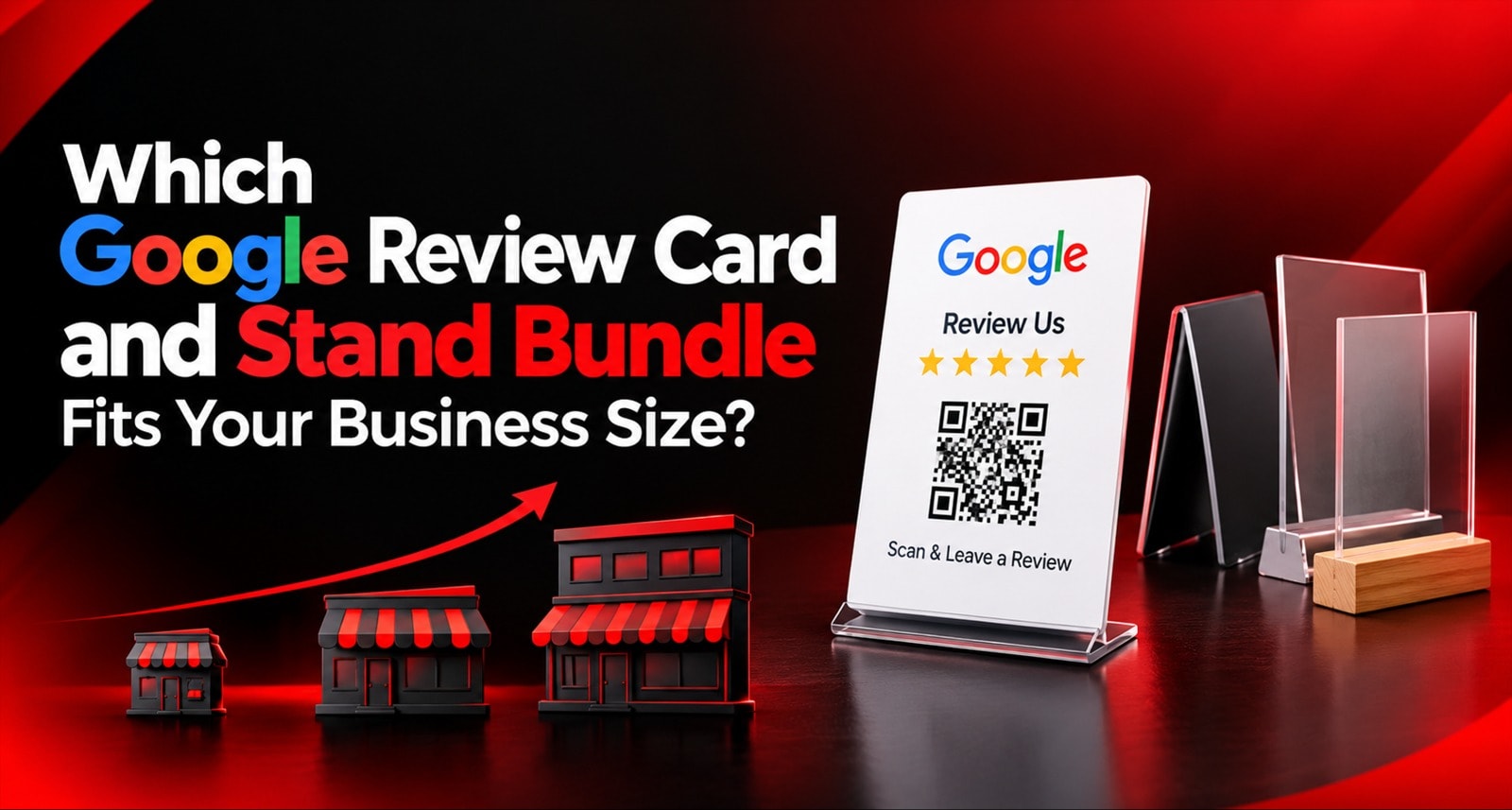
This guide works through five business sizes and gives each one a specific combination of cards, stands, pucks and tags — quantities, placement and rough cost included — so you can buy once and buy right.
The Rule That Decides Everything
Before any bundle, one principle.
Buy hardware for every place a customer pauses — not for every surface you own.
A customer only reviews when they're stopped and have a free moment: at the billing counter, at a table after eating, at reception while a card machine runs, during a handover. Hardware anywhere else is decoration.
So the question isn't "how big is my business?" in square feet. It's "how many distinct pause points do my customers have, and how many staff hand things over?" Size changes the answer to that question — which is why bundles differ by size.
The deeper reasoning on why customers don't review on their own is in Why Happy Customers Don't Leave Google Reviews.
The Four Building Blocks
Every bundle below is assembled from the same four formats. Prices are from the ReviewTAG site, inclusive of taxes and custom branding.
Format | From | What it's for |
Smart Card | ₹99 | Staff pockets, bill folders, handoffs, stations |
Review Tag (keychain) | ₹149 | Field staff, delivery riders, mobile teams |
Acrylic Stand | ₹299 | Billing counters, reception desks |
Desk Puck | ₹399 | Restaurant tables, consultation desks |
Each one carries both NFC and a QR code, and all of them run on one platform account — the annual plan that powers the drafting, private routing, dashboard and editable links. The hardware is a one-time cost; the plan is separate. What the plan covers is explained in One Plan, Everything Included: What ReviewTAG's Pricing Actually Covers.
Note: the combinations below are recommended starting kits, not fixed packages. Adjust quantities to your floor plan — the reasoning matters more than the exact numbers.
Bundle 1 — The Solo Kit
For: One-person or two-person businesses. A home salon, a single-chair barber, a freelance physiotherapist, a tutor, a small boutique, a consultant with a desk.
The pause points: Usually just one — the end of the appointment or the payment moment. Sometimes a second if you work at clients' locations.
Item | Qty | Cost |
Acrylic Stand | 1 | ₹299 |
Smart Cards | 5 | ₹495 |
Hardware total | ₹794 |
Where it goes:
Stand at wherever payment happens or the session ends
One card in your pocket or bag for home visits and off-site work
Remaining cards as spares — they get lost
Why this combination: The stand catches every customer who comes to you. The card catches the ones you go to. At this size, anything more is overbuying.
The one thing to get right: Say the line. At this scale there's no staff habit to build — it's just you. A conditional, twenty-second ask at the end of every appointment does more than any hardware. "If you enjoyed today, just tap your phone here."
Bundle 2 — The Single-Outlet Kit
For: One location with a small team. A café, a salon with four to six stations, a neighbourhood clinic, a single retail store, a small auto workshop.
The pause points: The counter, plus one or two in-experience moments — tables, stations, or handovers.
The right mix depends heavily on your type, so here are three variations of the same size:
2A — Café or small restaurant (6–8 tables)
Item | Qty | Cost |
Acrylic Stand (counter) | 1 | ₹299 |
Desk Pucks (tables) | 6 | ₹2,394 |
Smart Cards (servers) | 4 | ₹396 |
Hardware total | ₹3,089 |
2B — Salon (4–6 stations)
Item | Qty | Cost |
Acrylic Stand (reception) | 1 | ₹299 |
Smart Cards (one per station + spares) | 8 | ₹792 |
Hardware total | ₹1,091 |
The station cards are what matter here — the best review moment in a salon happens at the chair, not the desk. That's covered in How Salons and Spas Can Turn Great Appointments Into 5-Star Reviews.
2C — Clinic, retail store or workshop
Item | Qty | Cost |
Acrylic Stands (reception + billing, or one per till) | 2 | ₹598 |
Smart Cards (front desk / service advisors) | 4 | ₹396 |
Hardware total | ₹994 |
Why these combinations: One fixed point everyone passes, plus a mobile format for the moment the counter misses. The logic of pairing the two is set out in Google Review Stand & NFC Card Combo: Why Pairing Hardware Works Better.
The mistake to avoid at this size: Buying a desk puck for every surface in a salon or clinic. Pucks are for tables where customers sit and wait with a free hand. Consultation rooms in clinics should stay clear of any prompt entirely — the reasons are in How Clinics Can Collect Patient Reviews While Handling Sensitive Complaints Privately.
Bundle 3 — The Busy Venue Kit
For: A single larger location. A restaurant with 15–25 tables, a hotel, a multi-till retail store, a large gym, a dealership service centre.
The pause points: Several. Multiple counters or tills, many tables or rooms, and staff who move between customers.
Here's where sizing discipline really pays off, because the temptation is to put hardware on every table.
Restaurant with ~20 tables
Item | Qty | Cost |
Acrylic Stands (main counter + bar or takeaway) | 2 | ₹598 |
Desk Pucks (high-turnover tables) | 10 | ₹3,990 |
Smart Cards (servers + spares) | 10 | ₹990 |
Hardware total | ₹5,578 |
Why 10 pucks, not 20: Server cards cover the remaining tables at the bill-drop moment. Half the tables with pucks plus every server carrying a card reaches the same guests for a lot less — and you'll learn from the data which tables actually convert.
Hotel
Item | Qty | Cost |
Acrylic Stands (reception + restaurant) | 2 | ₹598 |
Desk Pucks (restaurant tables, selectively) | 6 | ₹2,394 |
Smart Cards (concierge, bell desk, in-room) | 15 | ₹1,485 |
Hardware total | ₹4,477 |
In-room cards are the most underused placement in hospitality — a relaxed guest in the evening writes a warmer review than a departing one managing luggage. More on that in Retail, Hotels and Auto Workshops: One Tag, Every Counter.
The habit that matters at this size: Separate codes for each zone. A busy venue running everything through one code learns nothing. Counter, tables, bar, rooms — each gets its own, so you can see which zone works. Setup is in QR Code Management: One Code Per Table, Counter or Campaign.
Bundle 4 — The Multi-Branch Kit
For: Two to ten locations under one brand. Restaurant chains, clinic groups, salon franchises, retail chains, service-centre networks.
The pause points: The same as a single outlet — repeated at every branch.
This is where the second mistake from the introduction lives. Every branch has its own Google listing, competing in its own local radius. Hardware at the flagship does nothing for the branch across town.
Example: three-branch business
Item | Per branch | × 3 branches | Cost |
Acrylic Stand | 1 | 3 | ₹897 |
Smart Cards | 6 | 18 | ₹1,782 |
Base total | ₹2,679 |
Add per-branch extras by type — pucks for restaurant branches, more station cards for salons.
Three rules for multi-branch:
1. Standardise the core kit. Same stand placement, same card allocation, at every branch. It makes training simpler and the data comparable.
2. One code per branch, minimum. Without it, a blended rating can hide a struggling location completely. A 4.4 average might really be 4.7 and 3.9.
3. Weight new branches more. A newly opened location needs reviews urgently to compete locally. Give it extra cards and brief its team first.
All branches run on one platform account, and code generation isn't capped — what scales with branches is the hardware, not the software. How to read multi-branch numbers properly is in Review Analytics That Matter: Reviews, Ratings, Responses and Trends.
Bundle 5 — The Field Team Kit
For: Businesses where staff go to the customer. Pest control, AC servicing, home cleaning, delivery-first kitchens, real estate, installation teams, mobile mechanics.
The pause points: The doorstep, the job completion, the handover — wherever your staff are when the work is finished.
Item | Qty | Cost |
Review Tags (one per field staff, 10-person team) | 10 | ₹1,490 |
Smart Cards (spares, supervisors) | 4 | ₹396 |
Acrylic Stand (office, if customers ever visit) | 1 | ₹299 |
Hardware total | ₹2,185 |
Why keychains over cards: Field staff carry keys, bags and tools. A keychain tag lives with the van keys or the toolbag and is far harder to lose than a card in a pocket. The format is covered in Google Review Keychain: The Review Tool for On-the-Go Teams.
If your team's hands are constantly busy — riders with parcels, servers with plates — wearables are worth considering too, discussed in QR Silicone Bracelet and Wearable Review Tags for Frontline Staff.
The rule for field teams: The ask happens after the work is explained, never before. "Everything's done — here's what we fixed. If the service worked for you, a quick tap here helps a lot."
All Five at a Glance
Bundle | Typical business | Core hardware | Approx. hardware cost |
Solo | Home salon, freelancer, boutique | 1 stand + 5 cards | ₹794 |
Single outlet | Café, salon, clinic, store | 1–2 stands + cards (+ pucks for cafés) | ₹994–₹3,089 |
Busy venue | Large restaurant, hotel | 2 stands + selective pucks + cards | ₹4,477–₹5,578 |
Multi-branch | 2–10 locations | Standard kit × branches | ~₹893 per branch + extras |
Field team | Service and delivery teams | Keychain tags + spare cards | ₹2,185 for 10 staff |
Plus one platform plan regardless of size — ₹14,999 a year, currently ₹4,999 as a launch offer. For a fuller view of what review hardware should cost and what's fair to pay, see What a Google Review Stand Should Really Cost in India in 2026.
How to Tell If You Sized It Wrong
Give it four weeks, then check your dashboard per code.
What you see | What it means | What to do |
One code does almost everything | Other placements are in the wrong spot | Move them, don't buy more |
A code at zero | Hardware is hidden, damaged or forgotten | Physically check it today |
Staff cards far below the stand | The habit hasn't formed | Re-brief, don't rebuy |
A branch far below the others | Training or management gap | Visit that branch first |
Everything converting evenly | Sized about right | Leave it alone |
Notice that almost none of these say "buy more hardware." Underperformance is nearly always a placement or habit problem. Adding units on top of a bad placement just gives you more units in bad places.
Five Sizing Mistakes
❌ Buying by discount tier. Twenty stands at a great unit price is worse value than four in the right places.
❌ One stand for many branches. Each Google listing needs its own reviews.
❌ Pucks on every table on day one. Start with half, let the data show which tables convert, then fill in.
❌ No spares. Cards and tags get lost. Order 15–20% over headcount.
❌ Forgetting the people. Hardware without a one-line script and a short team briefing collects a fraction of what it could. Every bundle above assumes your team knows when to offer it and what to say.
Explore the ReviewTAG Collection with Dynamic QR Codes →
Create Your ReviewTAG Business Account — Sign Up Now →
Talk to Our Team on WhatsApp for a Free Setup Demo
FAQs
How many google review stands do I need?
One per place customers pause standing up — usually the billing counter or reception. Most single-outlet businesses need one or two, not more.
Do I need a separate platform plan for each branch?
No. One account covers all branches, and QR code generation isn't capped. Hardware is what scales with locations.
Should every restaurant table get a desk puck?
Not to begin with. Cover your busiest tables and give servers cards for the rest. Expand once the data shows which tables convert.
Is a card or a keychain better for field staff?
Keychain, usually. It travels with keys or tools and is much harder to lose than a pocket card.
Can I add more hardware later?
Yes. New stands and cards connect to the same account. Starting small and expanding on evidence is the better approach.
What if I move or change my Google listing?
Every format uses a dynamic code, so you update the destination in your dashboard and all your hardware follows. Nothing needs reprinting.
More answers on the FAQ page.
About the author

Chandu Venkata Satish
Founder & Director
Chandu Venkata Satish is an entrepreneur, digital strategist and technology-driven business consultant with over ten years of experience working across digital strategy, political consulting, branding and technology. As the Founder of Technical Avengers, he leads the development of practical digital solutions that help businesses strengthen their online presence and accelerate growth. Review TAG is one such product, developed to simplify customer feedback and review generation through AI, QR and NFC technology, helping businesses turn genuine customer experiences into digital trust.
LinkedIn