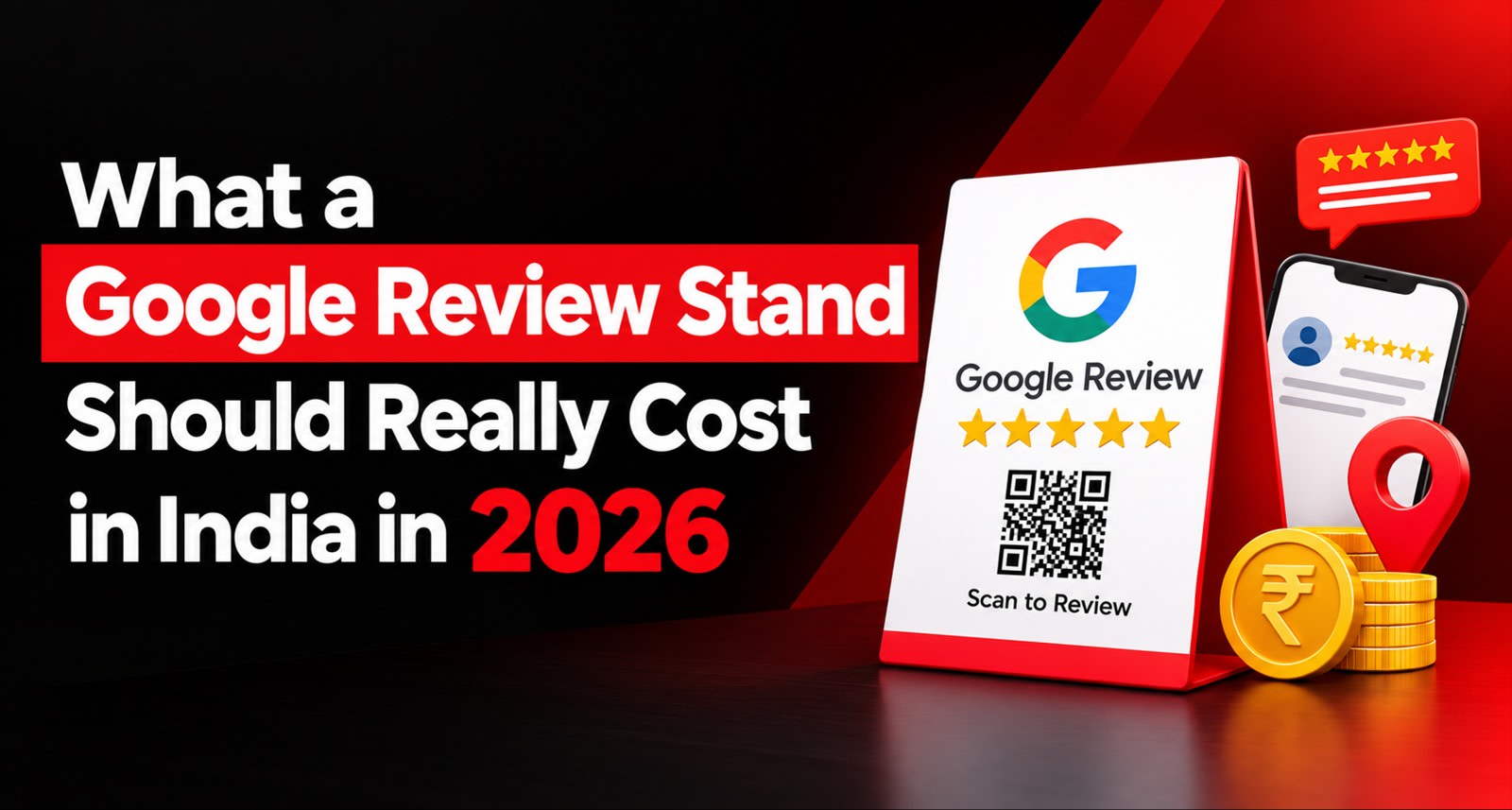
Search for a Google review stand in India and you'll find quotes ranging from ₹30 to over ₹2,000 for what looks, in the listing photos, like broadly the same object.
A piece of acrylic with a QR code on it.
That spread isn't random, and it isn't mostly about markup. What you're actually paying for sits mostly outside the physical stand — and the businesses that only compare the printed price are the ones who end up buying twice.
Here's what sits inside each price band, what a fair number looks like in 2026, and where the genuine traps are.
Why the Price Range Is So Wide
Four things drive cost, and only one of them is visible in a product photo.
Cost driver | Impact on price | Visible in a photo? |
Material and build | Moderate | Partly |
NFC chip | Moderate | No |
Custom branding | Moderate | Yes |
Software behind the code | Largest | No |
That last row explains most of the spread. A ₹30 stand and a ₹400 stand can look identical and behave completely differently, because one opens a blank Google review box and the other opens a guided flow you control from a dashboard.
The physical object is, in a sense, the cheapest part of the decision.
The Price Bands, Honestly Described
🔸 ₹20–₹60 — Printed card or basic laminate
What you get: A paper or laminated card with a printed QR. Often a generic template with your link pasted in.
What it does: Opens your Google review page. Nothing else.
What breaks: It warps, fades and tears. Kitchen grease and counter spills end it. And critically, the link is permanent — if your Google Place ID changes or you move premises, every single piece becomes waste.
Honest verdict: Better than nothing. Genuinely. But it's a prompt, not a system — and it leaves your customer staring at a blank text box, which is where most review attempts die. That failure is covered properly in Why Happy Customers Don't Leave Google Reviews.
🔸 ₹80–₹200 — Printed acrylic, static QR
What you get: A proper acrylic stand, decent print, your logo. Looks respectable on a counter.
What it does: Still just opens the Google review box. No NFC in most cases at this price.
What breaks: Nothing physically — this is where durability genuinely starts. But the static link problem remains, and there's no data, no filtering, no dashboard.
Honest verdict: You've solved the durability problem and none of the conversion problems. Reasonable if you only ever wanted a physical sign.
🔸 ₹250–₹500 — Acrylic with NFC and a managed link
What you get: Acrylic build, embedded NFC chip, custom branding, and — the important part — a link that stays editable from a dashboard.
What it does: Tap or scan. Opens a guided experience rather than a blank box. Low ratings route privately. You can repoint it without reprinting.
What breaks: Nothing, if the platform stays live. The dependency moves from the plastic to the subscription.
Honest verdict: This is where a review stand stops being signage and starts being infrastructure. For reference, ReviewTAG's Acrylic Stand sits at ₹299 with taxes and custom branding included.
🔸 ₹600–₹2,000+ — Premium materials and bespoke builds
What you get: Metal, wood, backlit or illuminated units, fully bespoke shapes, or agency-designed pieces.
What it does: Functionally the same as the ₹300 band. The extra cost is aesthetics and materials.
Honest verdict: Justified for luxury hospitality, premium salons, flagship stores and anywhere the counter itself is part of the brand experience. Not justified for a neighbourhood café. You're buying furniture, not function.
The Comparison That Actually Matters
Here's what the price difference buys, laid against what the stand does for your business.
₹30 printed card | ₹299 NFC acrylic | |
Durable for 12+ months | ❌ | ✅ |
Works by tap (no camera) | ❌ | ✅ |
Helps the customer write | ❌ | ✅ |
Filters low ratings privately | ❌ | ✅ |
Editable link, no reprint | ❌ | ✅ |
Per-code tracking | ❌ | ✅ |
Custom branding | Usually extra | Included |
Five of those seven rows have nothing to do with the stand and everything to do with the software behind the code. Which is why comparing stand prices alone produces a misleading answer.
The Twelve-Month Cost Nobody Calculates
Upfront price is the wrong number. Here's what a counter actually costs over a year.
Scenario A — Cheap printed cards
Item | Cost |
Initial print (5 counters) | ₹250 |
Replacement, quarter 2 | ₹250 |
Replacement, quarter 3 | ₹250 |
Reprint after a listing change | ₹250 |
Design time (your own hours) | — |
12-month total | ₹1,000 |
Plus every review lost to a blank box, a faded code, or three weeks of a dead link nobody noticed.
Scenario B — NFC acrylic stands
Item | Cost |
5 acrylic stands @ ₹299 | ₹1,495 |
Replacements | ₹0 |
Reprint after a listing change | ₹0 (remapped in dashboard) |
12-month hardware total | ₹1,495 |
The hardware gap over a year is about ₹500. Which, framed properly, means the durability argument is roughly a wash — and the entire real difference is the functionality the cheap option simply doesn't have.
Where the Real Cost Sits: The Subscription
Be clear about this, because it's the part cheap competitors leave out of their comparison.
An NFC stand connected to a managed platform requires an active subscription. The stand is one-time; the software is annual.
Component | Type | ReviewTAG |
Hardware | One-time | Acrylic stand from ₹299 |
Platform | Annual | ₹14,999/yr, currently ₹4,999 launch offer |
Is the subscription a catch? Only if you think the plastic is the product. Everything that converts a scan into a published review lives in software — the questionnaire, the AI drafting, the rating fork, the dashboard, the editable link. Pull the subscription and you have an expensive static QR.
The full breakdown of what the plan does and doesn't cover is in One Plan, Everything Included: What ReviewTAG's Pricing Actually Covers.
Stand vs Other Formats: Getting the Mix Right
A stand isn't always the right spend. Price per unit varies by format, and so does what each one is good at.
Format | Price from | Best for |
Smart Card | ₹99 | Staff pockets, bill folders, handoffs |
Review Tag (keychain) | ₹149 | Field teams, delivery, mobile staff |
Acrylic Stand | ₹299 | Billing counters, reception desks |
Desk Puck | ₹399 | Restaurant tables, consultation desks |
Most businesses are better served by two formats than five stands. A restaurant with one counter and twelve tables doesn't need thirteen acrylic stands — it needs one stand plus table pucks, or one stand plus server cards.
The reasoning behind pairing a fixed placement with a mobile one is in Google Review Stand & NFC Card Combo: Why Pairing Hardware Works Better, and the case for the counter specifically is in Google Review Stand for the Billing Counter: Placement That Converts.
How Many Stands Do You Actually Need?
Overbuying is the most common costly mistake, and it's driven by a simple error: buying by location count rather than by pause count.
A customer only reviews where they stop. Count the places people genuinely pause.
Business | Stands needed | Supplement with |
Single-counter café | 1 | Table pucks or cards |
Restaurant, 1 counter + 12 tables | 1 | 12 desk pucks |
Salon, reception + 6 stations | 1 | 6 smart cards |
Clinic, reception + billing | 2 | Front-desk cards |
Retail, 3 tills | 3 | — |
Hotel, reception + restaurant | 2 | In-room tags |
Auto workshop | 1 (billing) | Advisor cards |
Field-only team | 0 | Keychain tags only |
That last row is worth noting. A business whose staff never stand behind a counter should spend nothing on stands — the format comparison for mobile teams is in QR Silicone Bracelet and Wearable Review Tags for Frontline Staff.
Four Traps When Buying in India
❌ Trap 1 — "Custom design extra."
A quoted price of ₹150 becomes ₹400 once branding, setup and artwork charges are added. Always ask whether the quote includes logo printing, taxes and shipping. ReviewTAG's listed prices include taxes and custom branding; many don't.
❌ Trap 2 — Static codes sold as smart.
Some vendors sell "NFC stands" where the chip points to a permanent URL. You get the tap convenience with none of the remapping flexibility. Ask one question: can I change where this points, from a dashboard, after printing? If the answer is vague, it's static.
❌ Trap 3 — Buying on bulk discount you don't need.
A hundred stands at a great unit price is worse value than eight stands in the right places. Buy by pause count, not by discount tier.
❌ Trap 4 — Vendors promising review numbers.
Anyone guaranteeing "500 reviews in 60 days" is either selling fake reviews or will quietly under-deliver. No hardware can promise a number, and promising one should end the conversation.
What a Fair 2026 Price Looks Like
Pulling it together, here's the honest benchmark:
You're buying | Fair range | Red flag |
Printed QR card | ₹20–₹60 | Over ₹100 |
Plain acrylic, static QR | ₹80–₹200 | Over ₹300 |
NFC acrylic, managed link | ₹250–₹500 | Over ₹800 without premium materials |
Premium bespoke | ₹600–₹2,000 | Only justified by materials |
Annual platform | ₹4,000–₹15,000 | Per-review or per-location charges |
Two things that should always be included at any price above ₹200: custom branding, and taxes. If either is quoted separately, the headline number isn't the real number.
Explore the ReviewTAG Collection with Dynamic QR Codes →
Create Your ReviewTAG Business Account — Sign Up Now →
Talk to Our Team on WhatsApp for a Free Setup Demo
FAQs
How much does a google review stand cost in India?
A durable NFC acrylic stand with custom branding sits fairly at ₹250–₹500. Printed cards run ₹20–₹60 but lack the functionality. Premium materials push past ₹600.
Is a review stand a one-time cost?
The stand is. If it's connected to a managed platform, the software is an annual subscription — that's what keeps the drafting, routing, dashboard and editable link working.
Are cheap QR stands worth buying?
For a temporary stall or a tight budget, yes — better than no prompt at all. For a permanent counter, the twelve-month cost is close and the functionality gap is large.
Why does an NFC stand cost more than a printed one?
Partly the chip and the acrylic, mostly the software behind the code. The physical difference is small; the behavioural difference isn't.
Do I need one stand per table?
No. Tables are better served by desk pucks, which are designed to sit flush on a surface. Stands belong at counters where customers pause standing up.
Does the price include GST and branding?
It should. ReviewTAG's listed hardware prices include taxes and custom branding. Always confirm with any vendor, because this is the most common source of quote inflation.
Can I change the Google link after the stand is printed?
With a managed, dynamic code, yes — update the destination in your dashboard and every stand follows. With a static printed code, no. That single question separates the two categories.
About the author

Chandu Venkata Satish
Founder & Director
Chandu Venkata Satish is an entrepreneur, digital strategist and technology-driven business consultant with over ten years of experience working across digital strategy, political consulting, branding and technology. As the Founder of Technical Avengers, he leads the development of practical digital solutions that help businesses strengthen their online presence and accelerate growth. Review TAG is one such product, developed to simplify customer feedback and review generation through AI, QR and NFC technology, helping businesses turn genuine customer experiences into digital trust.
LinkedIn