Picture a server mid-shift on a Saturday. Both hands carrying plates. Apron pockets full of a pen, an order pad, a lighter, someone's change. They've just dropped food at a table and the guest says, genuinely, "this looks amazing."
Now ask them to produce a review card.
They'd have to put down the plates, dig through a pocket, find the card, hand it over, explain it. By the time all that happened, the moment was gone and so is the server table six is waving.
This is the problem wearables solve. Not a different technology, just a different place to keep it: on the body instead of in a pocket. For a large category of frontline staff, that single change is the difference between a tool that gets used and one that stays in a drawer.
The Staff Nobody Designs Review Hardware For
Most review hardware assumes a counter. A stand sits on it, a customer walks up to it, the transaction happens there.
But a significant share of frontline workers have no counter at all, and the standard tools fail them in predictable ways:
Role | Why a counter stand fails | Why a pocket card fails |
Restaurant servers | Customer pays at table or leaves fast | Hands full, pockets cluttered |
Delivery riders | No premises contact whatsoever | Gloves, helmet, bag, one hand on the phone |
Salon assistants | Moving between stations constantly | Wet hands, products, no free pocket |
Hospital & clinic aides | Serve in corridors and rooms | Hygiene protocols discourage pocket items |
Hotel housekeeping | Never at reception | Uniform pockets, trolley, linens |
Gym trainers | On the floor, not behind a desk | Gym wear often has no pockets at all |
Event & venue staff | Mobile by definition | Lost within one shift |
Field technicians | Work at the customer's site | Toolbag, grease, cards get ruined |
The pattern is consistent: hands busy, body moving, no fixed position. For these roles the question isn't which format is best in theory, it's which format is physically possible to use in the four seconds the moment lasts.
The underlying issue, that the prompt has to reach the customer at their happiest rather than the other way round, is covered in Why Happy Customers Don't Leave Google Reviews.
Why Pocket Cards Quietly Fail
A google review card in a staff pocket is a genuinely good tool for roles that have a natural handoff and a free hand. The reasoning behind those is in Google Review Business Cards for Staff: Turning Every Handoff Into a Review.
For hands-busy roles, four things go wrong:
They get lost. Cards migrate to lockers, bags, home, the wash. Most teams lose a meaningful share within the first month.
They require two hands and ten seconds. Retrieving something from a pocket while holding anything is awkward, and awkward actions don't become habits.
They're invisible. A card in a pocket prompts nobody. Nobody looks at it. Nobody asks about it. It only exists if the staff member remembers it.
They degrade. Grease, water, sweat, laundry. A card handled across a hundred shifts stops looking like something you'd hand a customer.
That third point is the most underrated. A pocket card is a purely active tool; it works only when a staff member decides to use it. A wearable is partly passive: it's visible all the time, so some customers ask about it unprompted, and staff get reminded simply by seeing it on their own wrist.
What a Wearable Review Tag Actually Is
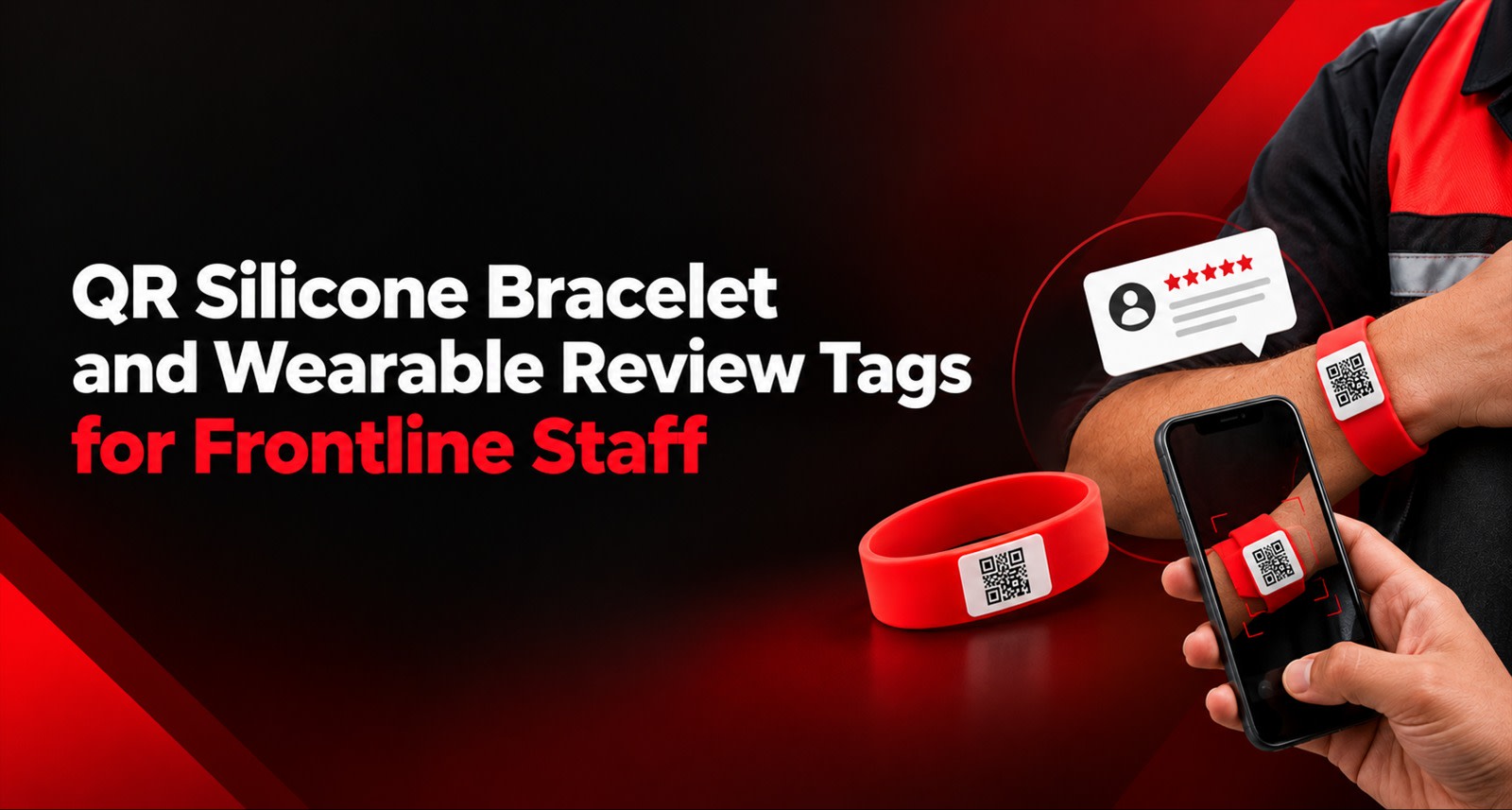
A silicone wristband is the same material as a fitness band or an event wristband carrying a printed QR code and, in NFC versions, an embedded chip.
The customer taps their phone against it or scans the code. A guided review flow opens. No app, no account, no typing into a blank Google box. Identical to every other format in the range the experience is explained in Simple Tap or Scan: How ReviewTAG Works Without Any App Download.
What's different is purely physical:
Property | Why it matters at work |
Worn, not carried | Can't be left behind, can't be lost mid-shift |
Always visible | Prompts staff and customers passively |
One-handed | Extend my wrist. That's the whole action. |
Waterproof | Wash areas, kitchens, rain, sweat |
Wipeable | Important in food and clinical settings |
Comfortable all day | Nothing in a pocket digging in |
The "extend your wrist" action is deceptively important. A server holding plates can still offer their wrist. A rider holding a parcel can. A trainer spotting a lift can finish the set and lift an arm. There is no format with a lower physical cost of use.
Where the Ask Happens, Role by Role
A wearable only works if the staff member knows when to offer it. For each role there's one obvious moment.
🍽️ Restaurant servers
At the table, after the guest says something positive about the food, or when clearing plates at the end of the meal. Not while they're eating.
🛵 Delivery riders
At the doorstep handover, as the parcel changes hands. This is the only physical contact a delivery-first business ever gets, which makes it disproportionately valuable.
💇 Salon assistants and juniors
At the wash basin or during processing the idle window where the client is sitting still with their phone and nothing to do. The fuller salon playbook, including the chair-spin moment, is in How Salons and Spas Can Turn Great Appointments Into 5-Star Reviews.
🏨 Hotel housekeeping and bell staff
After a request is fulfilled an extra pillow delivered, luggage carried up. Small acts of service generate warm, specific reviews.
🏋️ Gym trainers
End of a session, especially after a visible milestone. The customer has just felt progress, which is the strongest review fuel in fitness.
🔧 Field technicians
After explaining the work completed. The explanation earns the ask never before it.
🏥 Clinic support staff
At discharge only, and never anywhere near a consultation. Healthcare has particular constraints that are worth reading properly in How Clinics Can Collect Patient Reviews While Handling Sensitive Complaints Privately.
The Script When You're Wearing It
A wearable makes the ask more casual, which is an advantage if your team uses it well and a liability if they don't.
What works
✅ Server, clearing plates:
"Glad you enjoyed it. If you want to leave a quick review, just tap your phone takes twenty seconds."
✅ Delivery handover:
"Thanks! If the delivery was good, you can tap here."
✅ Trainer, end of session:
"Good work today. If you're enjoying the sessions, tap here takes a few seconds."
✅ When a customer notices it first:
"Oh, this? It's for Google reviews. If you tap your phone on it, it writes most of it for you."
That last one is unique to wearables and worth briefing staff on explicitly. Customers will ask about an unusual band on someone's wrist. A staff member who can answer in one friendly sentence converts curiosity into a review without ever having to make the ask.
What doesn't
❌ "Please give us 5 stars" asking for a rating, not feedback.
❌ Thrusting a wrist at someone mid-conversation physical proximity makes a pushy ask feel pushier.
❌ Asking twice. Once is an offer; twice is pressure.
❌ Asking while the customer is eating, mid-treatment or on the phone.
And the rule that overrides everything: never offer anything in exchange for a review. No free dessert, no discount, no extra session. It's a direct policy violation and one enthusiastic staff member can create the problem without realising it. Say it out loud in the briefing. The boundaries are set out in the Terms & Conditions.
Wearable vs Every Other Format
Honest comparison wearables are not universally better, they're better for a specific set of conditions.
Counter stand | Pocket card | Keychain | Silicone bracelet | |
Needs staff action | No | Yes | Yes | Yes |
Hands needed | Two | One or two | One | |
Visible to customers | Yes | No | Partly | Yes |
Survives a shift | Yes | Sometimes | Usually | Yes |
Works off-premise | No | Yes | Yes | Yes |
Waterproof | N/A | No | Varies | Yes |
Best for | Fixed counters | Handoff roles with free hands | Mobile teams with bags/keys | Hands-busy, moving roles |
The practical reading: a bracelet is the right answer when hands are busy and the role has no counter. Where staff do have a free hand and a natural handoff, a card works fine. Where they carry keys or a bag, a keychain tag may suit better that format is covered in Google Review Keychain: The Review Tool for On-the-Go Teams.
And none of these replace a counter stand where you have a counter. Most businesses end up running two formats: something fixed at the paying point, something mobile on the staff who never reach it. That pairing logic is in Google Review Stand & NFC Card Combo: Why Pairing Hardware Works Better.
Practical Details Worth Getting Right
Sizing. Order a mix of sizes or adjustable bands. A band that's too tight gets removed within an hour and never goes back on. This is the most common reason wearable rollouts quietly fail in week two.
Colour coding. Use colour to encode something useful: role, branch, or shift. A restaurant might use one colour for servers and another for the bar team. It's free segmentation and makes a quick visual check possible across a floor.
Laundry and lockers. Silicone survives water but not a tumble dryer. Build a simple end-of-shift habit: bands go in a tray at the staff station, not into uniform pockets heading for the wash.
Hygiene in food and clinical settings. Wipeable is the whole point here, but check your own protocols first; some kitchens and clinical areas restrict wrist-worn items entirely. Where they do, a clip-on or lanyard tag is the alternative.
Spares. Order 15–20% more than headcount. Bands get lost, snapped, and taken home.
Replacement cycle. Silicone lasts, but branding on heavily-used bands fades. Plan on refreshing annually rather than treating it as permanent.
Measuring Without Creating a Problem
Give wearables their own code separate from your counter stand so you can actually see what the mobile team contributes.
Comparison | What it reveals |
Bracelet code vs counter code | Whether mobile staff are adding volume or just shifting it |
Role colour vs role colour | Which team the habit actually stuck with |
Week 2 vs week 6 | Whether it survived past the novelty period |
Shift A vs shift B | Where briefing landed and where it didn't |
That week 2 vs week 6 comparison is the one to watch. Most staff-tool rollouts peak early and decay. A one-line mention in the weekly huddle prevents it.
Setting up separate codes takes a few minutes. The method is in QR Code Management: One Code Per Table, Counter or Campaign, and the monthly reading framework is in Review Analytics That Matter: Reviews, Ratings, Responses and Trends.
⚠️ One thing not to do
Do not set individual review targets per staff member. The moment someone's appraisal depends on their review count, someone will start asking customers for five stars or implying it helps them personally. Colour-coded bands make individual tracking technically easy, which makes this temptation worse, not better.
Recognise at team level instead. Read out reviews that named staff by name in the weekly huddle that motivates better than a leaderboard and keeps you well inside what's acceptable.
A Two-Week Rollout
Days 1–3 Brief properly.
Explain why reviews matter to the business and to them. Hand out bands, check sizing, teach one line, practise it twice. Also teach the "customer asks about it" answer.
Days 4–10 Watch and adjust.
Listen to how staff actually phrase it. Some will find a better line than yours; adopt it. Fix sizing complaints immediately; a band that's uncomfortable will be off by Friday.
Days 11–14 Share results.
Show what came in. Reviews naming staff are the single best motivator available. This is the week the habit sets or dies.
Then monthly. One mention in the team meeting, one look at the numbers. That's enough.
Explore the ReviewTAG Collection with Dynamic QR Codes →
Create Your ReviewTAG Business Account — Sign Up Now →
Talk to Our Team on WhatsApp for a Free Setup Demo
FAQs
Do customers actually tap a wristband?
Yes, more readily than people expect, because it's novel and the action is obvious. Several customers will ask about it before being asked anything.
Is it hygienic in food or clinical settings?
Silicone wipes clean, which is why it's used for medical ID bands. But check your own protocols first; some kitchens and clinical areas prohibit wrist items entirely.
What if the band gets damaged?
The printed QR and the NFC chip are separate paths to the same place, so a scratched surface or a failed chip rarely kills it entirely. Keep spares regardless.
Can each staff member have a different code?
Technically yes. Think carefully before doing it per-person tracking invites per-person targets, which is where problems start. Role-level or shift-level is usually the better resolution.
Does a bracelet replace a counter stand?
No. Different moments. Run both if you have a counter at all.
Do staff mind wearing them?
Mostly no, if they're comfortable and look reasonable. Fit is the whole battle; an uncomfortable band is simply not worn.
About the author

Chandu Venkata Satish
Founder & Director
Chandu Venkata Satish is an entrepreneur, digital strategist and technology-driven business consultant with over ten years of experience working across digital strategy, political consulting, branding and technology. As the Founder of Technical Avengers, he leads the development of practical digital solutions that help businesses strengthen their online presence and accelerate growth. Review TAG is one such product, developed to simplify customer feedback and review generation through AI, QR and NFC technology, helping businesses turn genuine customer experiences into digital trust.
LinkedIn