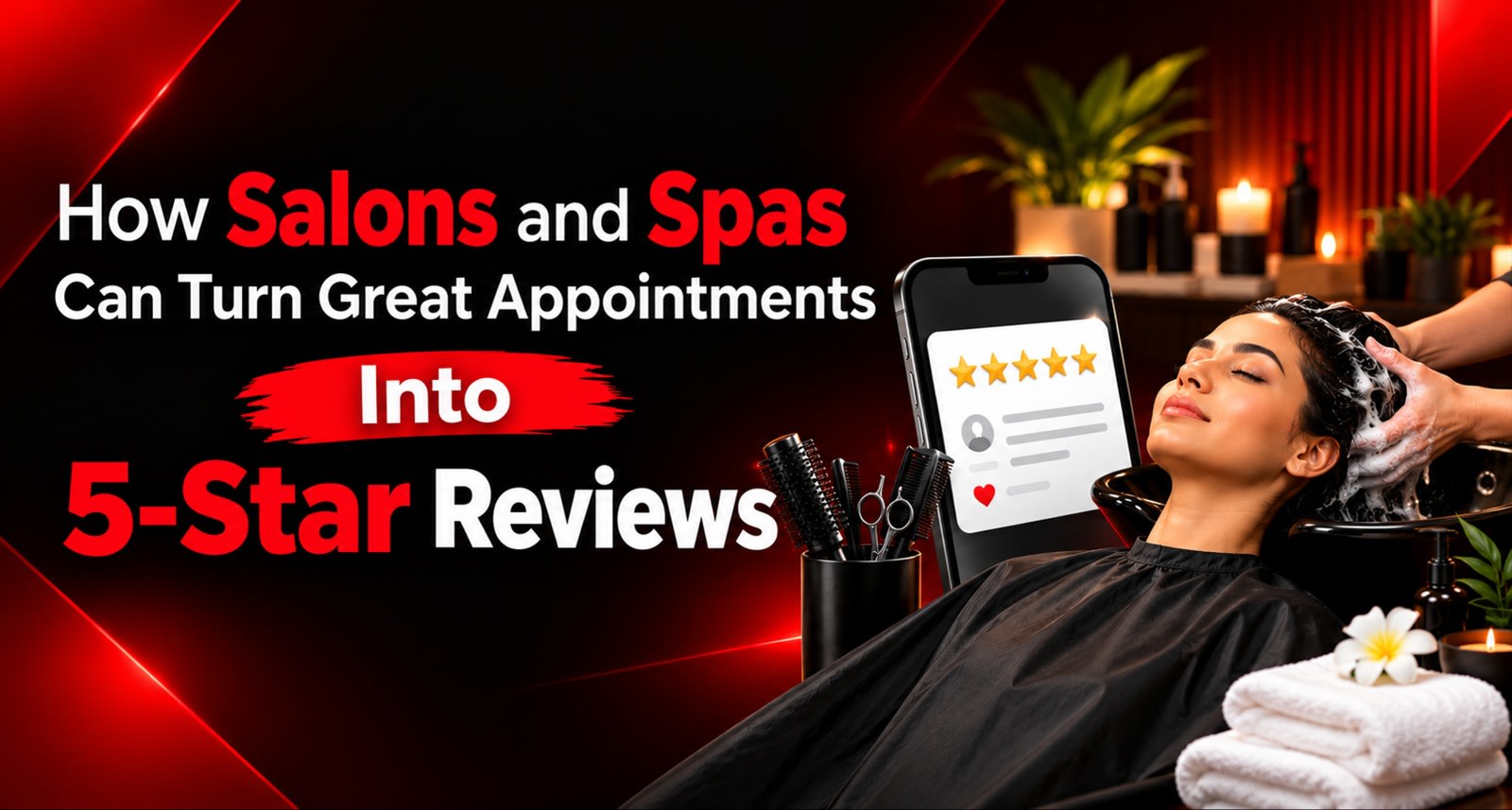
There's a second in every salon appointment that no other business gets.
The chair spins. The client sees themselves. And for about four seconds there's a completely unguarded reaction: a small smile, a hand going to the hair, sometimes an actual "oh, I love it."
That's the most honest positive feedback you will ever receive. It is specific, it is emotional, and it is happening while the client is physically in your chair with their phone in their bag.
And in most salons, absolutely nothing happens with it. Twenty minutes later they paid, rebooked, and left. By the evening the feeling has settled into normal. By the weekend they've forgotten to mention you to anyone.
That gap between the chair spin and the Google review that never gets written is the whole subject of this article.
Why Salons Have a Reviews Problem They Don't Deserve
Here's the uncomfortable truth about salon reviews: the ratio of delighted clients to clients who review is worse in beauty than in almost any other local sector.
Three reasons, and none of them are about the quality of your work.
The happiness peak is private. In a restaurant, the happy moment happens at a table with other people and a bill arrives. In a salon, it happens between one client and a mirror. It's intimate, not social, and intimate moments don't naturally spill into public posts.
The transaction is relational, not commercial. Your client has been chatting with their stylist for ninety minutes. Asking for a review afterwards can feel like it cheapens the relationship so stylists don't ask, and clients don't think to offer.
Beauty clients are quietly loyal. They come back for years without ever saying a word publicly. Loyalty without visibility is lovely for retention and useless for acquisition.
Meanwhile, the one group that does reliably post is the unhappy one. A client who hated their colour will write four paragraphs at 11pm. This is how a salon doing excellent work for hundreds of regulars ends up sitting at 4.1 on Google while a newer, worse salon down the road sits at 4.7.
The problem isn't your work. It's that nobody ever asks, at the moment it would be easy to say yes.
The Four Moments in a Salon Appointment
Not every point in an appointment is equally good for the ask. Three of these work; one quietly doesn't.
💇 Moment 1 - The reveal (strongest)
The chair spin. Highest emotional peak of the entire visit, and the stylist is right there. The ask lands as a natural extension of the conversation you were already having.
Best tool: a review card the stylist keeps at their station.
🧴 Moment 2 - The wash or processing wait (underrated)
Fifteen to forty minutes where the client is sitting still with their phone, mildly bored, with nothing to do. This is the only genuinely idle window in your entire business.
Best tool: a small card or stand at the wash basin or on the processing trolley.
💳 Moment 3 - The billing desk (reliable)
Standing, waiting for the card machine, winding down. Not the emotional peak, but a guaranteed stop for every single client.
Best tool: a stand at reception.
📱 Moment 4 - After they leave (weakest)
A WhatsApp message the next day. Response rates are poor, it feels like marketing, and it arrives when the feeling has already faded. Some salons swear by it; the data rarely supports it.
Verdict: use it as a backup, not a strategy.
The key insight: moments one and two both belong to the stylist, not to reception. If your entire review setup lives at the billing desk, you're only harvesting the weakest of the three good moments.
The Hardware Map for a Salon
Most salons need two or three placements, not one.
Placement | Format | Catches |
Stylist's station | Small NFC card or mirror-mounted tag | The reveal your best moment |
Wash area / trolley | Compact card or mini stand | The idle processing window |
Reception desk | Counter stand | Everybody, at payment |
Stylist's pocket | Google review business card | Mobile stylists, home visits, bridal work |
A note on the station card specifically
Salon stations are visually busy products, tools, towels and mirrors. A review card competing with eleven other objects gets ignored.
Two things that help: keep it close to the mirror edge where the client's eyes naturally go during the reveal, and keep it branded to match your interiors so it reads as part of the space rather than as an advertisement someone taped there.
If your stylists work off-site bridal parties, home appointments, weddings a card in their kit is the only option that travels. The thinking on staff-carried cards is covered in Google Review Business Cards for Staff: Turning Every Handoff Into a Review.
And whichever format you choose, the client experience is identical tap or scan, no app, no account. Which matters in a salon, because nobody is installing software with wet hands or foils in. That flow is explained in Simple Tap or Scan: How ReviewTAG Works Without Any App Download.
What a Salon Review Needs to Actually Say
This is where most beauty businesses leave real money on the table.
Compare these two genuine five-star reviews:
"Lovely salon, great service, really happy."
"Got a balayage done with Priya and she completely understood what I wanted from one photo. The salon is spotless and they didn't rush the consultation. Already booked my next appointment."
Both are honest. Both are from real clients. The first ranks for nothing and convinces nobody. The second does four jobs at once: it names a service people search for, names a stylist, signals hygiene, and signals that consultations aren't rushed.
The four things salon reviews should mention
Service names. Balayage, keratin, bridal makeup, pedicure, hair spa, smoothening. These are literally what people type into Google.
Stylist names. Enormous in beauty. Clients choose salons by person, not by brand. Named stylists also make reviews unmistakably genuine; nobody fabricates a name.
Hygiene and cleanliness. Post-pandemic, this is a top-three decision factor for salons and spas, and almost no salon seeds it deliberately.
The consultation. "Listened to what I wanted" is the single most reassuring phrase a nervous new client can read, because the universal fear is being given something they didn't ask for.
You don't write these. You simply make them available as options the client can tap, and configure the service names as keywords so the drafts reach for "balayage" rather than "hair colour." The setup for that is in Create a Review Questionnaire Quickly and Easily and Keyword Configuration: Making Every AI Review Work for Your Google Ranking.
Getting Stylists Named in Reviews
Worth its own section, because this is a beauty-specific advantage no other sector has.
A review naming a stylist does three things at once:
It's the most credible kind of review. Specific names read as unmistakably real.
It builds the stylist's personal book. New clients request people by name.
It gives you genuine performance data. You'll know within three months which stylists generate loyalty.
To make it happen, add stylist names as selectable options in your questionnaire, or let the client type the name in the optional free-text box. Most will, because they want to credit the person.
One caution
Do not turn this into individual review targets. The moment a stylist's appraisal depends on review count, someone will start asking clients for five stars, or implying that a review helps them personally. Both cross the line between asking for feedback and pressuring for a rating.
Recognise it at team level, read out the reviews that named people in your weekly huddle.
That motivates far better than a leaderboard, and it keeps you well inside what's acceptable. The boundaries are set out in the Terms & Conditions.
The Stylist Script
Stylists are already excellent at conversation; this just needs to sound like them rather than like a sales line.
What doesn't work
❌ "Ma'am, please give us a 5-star review" asks for a rating, not an opinion. Crosses the line and feels transactional after ninety minutes of friendly chat.
❌ "Could you possibly review us if you get a chance?" apologetic, vague, easy to forget.
❌ Handing the card silently it goes in the bag unread.
What works
✅ At the reveal:
"So glad you like it. If you want to share that, just tapping your phone here takes twenty seconds."
✅ During processing:
"You've got about twenty minutes. If you felt like sharing how it's gone so far, you can tap here totally up to you."
✅ At rebooking:
"Same time in six weeks, done. And if you enjoyed today, just tap here before you go."
The pattern in all three: conditional (if you like it / if you enjoyed it), specific (tap here), and time-bounded (twenty seconds). The condition removes pressure, the specificity removes confusion, the timing removes the objection.
Spas Need a Slightly Different Approach
A spa isn't a salon with dimmer lighting. The whole product is a mental state, and anything transactional breaks it.
Salon | Spa |
Energetic, chatty, social | Quiet, slow, decompressed |
Ask at the reveal | Never ask mid-treatment |
Visible station card works | Visible prompts feel intrusive in the treatment room |
Direct ask is fine | Softer, later ask is better |
Three spa-specific rules:
Never ask inside the treatment room. It shatters the experience you've just spent sixty minutes building, and it's the fastest way to turn a five-star feeling into a three-star one.
Ask in the relaxation lounge or at checkout. The client is back in the world, still calm, and the ask reads as hospitality rather than marketing.
Let the therapist hand off, not ask. "Rhea at the desk will sort your payment. There's a card there if you'd like to share how it went." Keeps the therapist in the role of caregiver.
Spa reviews also benefit from different vocabulary. Clients search for couples spa, deep tissue, prenatal massage, bridal package, hygienic spa not good service. Configure accordingly.
The Thing That Protects You: Where Unhappy Clients Go
Beauty generates a particular kind of complaint that other sectors don't: the emotional one.
A colour that came out two shades off. A fringe the client regrets by evening. A bridal trial that didn't match the inspiration photo. These are intensely personal, and they produce the most damaging public reviews in the sector because the client doesn't just feel badly served, they feel badly seen.
The rating-first flow matters more here than almost anywhere else. A client who taps two stars doesn't reach Google; they reach a private form, and your manager gets alerted while the client may still be in the building or at least reachable.
That's the difference between a colour correction offered the same evening and a permanent one-star review about a haircut you could have fixed for free. In beauty, the recoverable window is genuinely short, often the same day.
To be clear: nobody is stopped from posting publicly, and nobody should be. The routing changes who hears first, not whether the client has a voice. How to run that properly is covered in From Feedback to Fixes: Using the Private Feedback Dashboard.
A 30-Day Rollout for a Salon
Week 1 Set up and brief.
Configure your questionnaire with real service names, add stylist names, enable your local languages. Brief the team on why, and teach one line. Fifteen minutes in a morning huddle.
Week 2 Station cards only.
Start with the reveal moment alone. Don't roll out everything at once you want to know what the strongest placement actually produces.
Week 3 Add reception and wash area.
Now layer in the stand and the processing-window card. Use separate codes so you can tell them apart.
Week 4 Read the data and adjust.
Which placement produced most? Which stylist's clients review most, and what is that stylist doing differently? That's usually a script worth teaching everyone.
Month 2 onward monthly check.
Fifteen minutes. Velocity, rating spread, response rate, trend. The framework is in Review Analytics That Matter: Reviews, Ratings, Responses and Trends.
Salon-Specific Mistakes
❌ Only putting a stand at reception. You're skipping the two best moments in your business.
❌ Letting the station card get buried. Products pile up, towels land on it, it disappears by week three. Check placements physically every fortnight.
❌ Generic questionnaire options. Service, Quality, Experience produces reviews that mention no service you can be found for.
❌ Asking during a spa treatment. Covered above. Don't.
❌ Stylist review targets. Creates pressure, and pressure creates policy problems.
❌ Only asking regulars. Your loyal clients have already come back. New clients and one-off bridal or event bookings are the ones whose reviews bring strangers in.
Explore the ReviewTAG Collection with Dynamic QR Codes →
Create Your ReviewTAG Business Account — Sign Up Now →
Talk to Our Team on WhatsApp for a Free Setup Demo
FAQs
When exactly should a stylist ask?
At the reveal, or at rebooking. Not while the client is mid-treatment or under a dryer and can't comfortably respond.
Won't clients find it awkward after a long chat?
Only if the ask is demanding. A conditional, twenty-second ask reads as natural after ninety minutes of friendly conversation, often more natural than from a stranger at a counter.
Can clients mention a stylist by name?
Yes, and encourage it, add names as options or let them type it. It's the most valuable detail a salon review can carry.
What about bridal and on-location work?
A card in the stylist's kit is the only thing that travels. Bridal clients are also among your most enthusiastic reviewers, and they're currently your biggest missed opportunity.
How many reviews should a salon expect monthly?
With placements at the station, wash area and reception, most single-location salons see steady double-digit monthly volume once the habit sets. Placement and staff habit matter far more than footfall.
More answers on the FAQ page.
About the author

Chandu Venkata Satish
Founder & Director
Chandu Venkata Satish is an entrepreneur, digital strategist and technology-driven business consultant with over ten years of experience working across digital strategy, political consulting, branding and technology. As the Founder of Technical Avengers, he leads the development of practical digital solutions that help businesses strengthen their online presence and accelerate growth. Review TAG is one such product, developed to simplify customer feedback and review generation through AI, QR and NFC technology, helping businesses turn genuine customer experiences into digital trust.
LinkedIn