Agencies don't usually build products. We sell strategy, campaigns and growth, and we get paid when a client's business moves. So when Technical Avengers decided to build ReviewTAG, a physical tag and AI platform for Google reviews, a few people asked us a fair question:
Why would a growth agency make hardware?
The short answer: we kept solving the same problem by hand, for client after client, and it never stayed solved. This is the longer answer, and what building it taught us about Google reviews and local SEO.
The Problem We Couldn't Stop Seeing
Since 2020, most of our work has been with local businesses across Andhra Pradesh: cafés and restaurants in Vijayawada, clinics in Guntur and Mangalagiri, resorts along the coast, and real estate projects around Amaravati.
The local SEO work followed a familiar pattern. We'd rebuild the Google Business Profile, fix categories and photos, sort out the website, and set up tracking. Visibility would improve. Calls and footfall would follow.
And then the progress would flatten.
When we looked at why, the answer was usually sitting in the review section. A strong competitor down the road had several times more reviews. Our client's newest review was three months old. The few recent ones were complaints.
We'd tell clients to ask for reviews. They'd print a QR code. It would sit on the counter, slowly fading in the sun, and almost nobody would scan it.
What Google Reviews Actually Do for Local SEO
Before we explain what we built, it helps to understand why we cared so much.
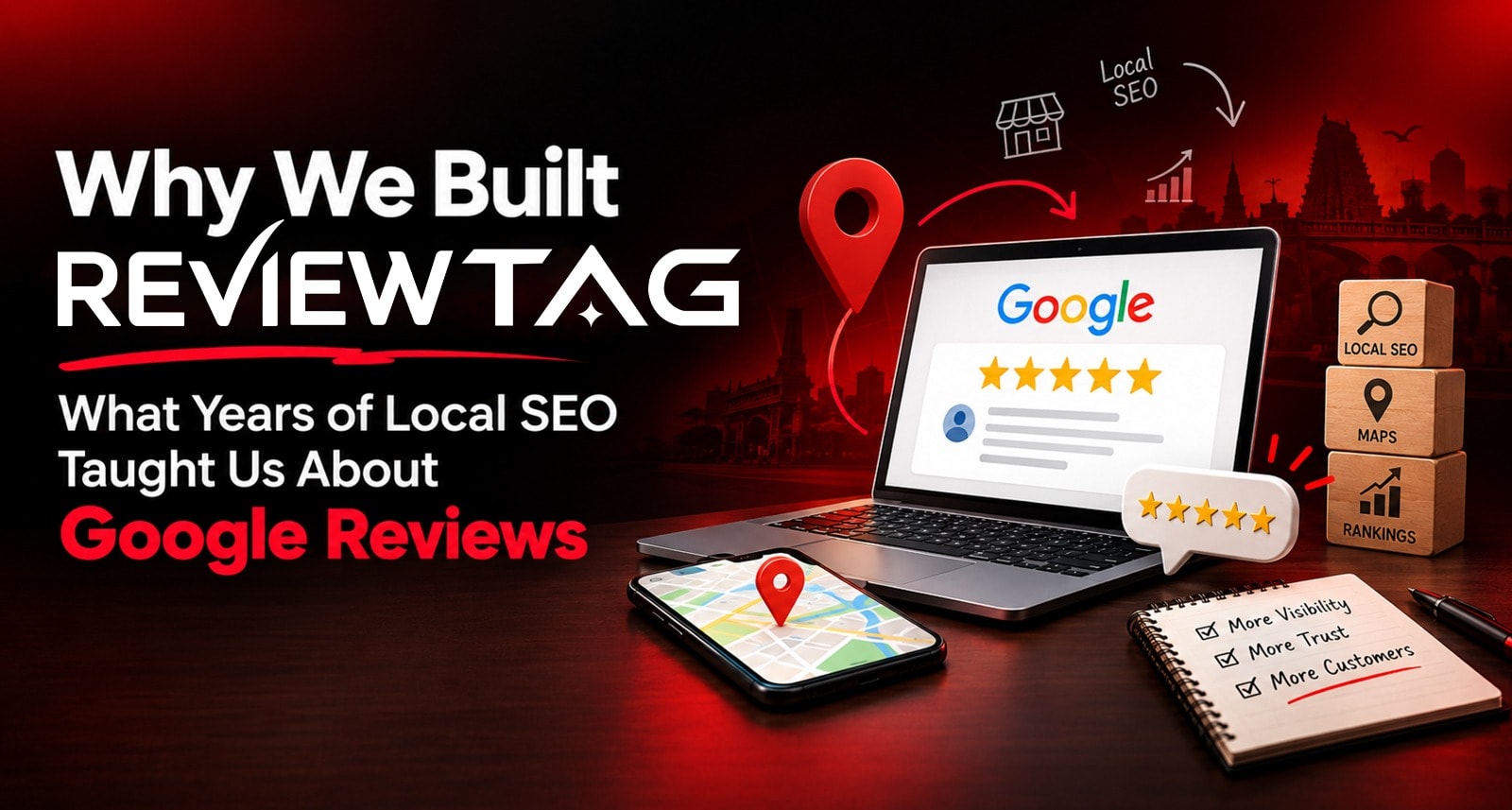
Google reviews affect local SEO in two ways: they're one of the signals Google uses to judge how prominent and trusted a business is, and they shape whether a searcher clicks on you once you appear. A listing with recent, detailed reviews tends to win both battles.
Google's own guidance on local ranking points to three broad factors: relevance, distance and prominence. Reviews feed into prominence. Review count, rating and freshness all contribute to how well known and trusted a business appears.
The second effect is easier to see. Picture someone searching "best dental clinic near me" in Guntur. Three results appear in the map pack. One has a 4.7 rating from a handful of old reviews. One has a 4.5 rating with hundreds of reviews and several from last week, describing specific treatments and named doctors. Which one gets the call?
Detailed, recent reviews also tend to mention the things people search for: dishes, treatments, services, neighbourhoods. That gives your listing more to match against the searches your customers actually type.
So reviews weren't a "nice to have" for our clients. They were the part of local SEO we couldn't directly control, and that bothered us.
Five Things We Learned (That Became Features)
Building ReviewTAG was mostly a process of taking what we'd seen in client businesses and designing around it. Here's how each lesson turned into a product decision.
What we kept seeing | What we built |
Customers stall at the empty review box | AI drafts a review from highlights the customer picks |
Printed QR codes broke when listings changed | Cloud-managed links you can repoint from the dashboard |
App downloads and logins killed the flow | Browser-only experience: scan or tap, nothing to install |
Owners found out about problems too late | A private feedback inbox so managers hear first |
A poster on the wall gets ignored | Physical formats for every touchpoint: keychains, cards, stands, desk pucks |
Lesson 1: The blank box is the enemy
People don't avoid reviews because they're lazy. They avoid them because writing well on the spot is hard. We noticed that customers were happy to talk about what they liked. "The staff was very friendly." "Biryani was spicy, just right." They just didn't want to compose it.
So ReviewTAG asks customers to tap what stood out, and AI turns those taps into a natural review. The customer reads it, edits it, and posts it. The words are shaped by AI, but the experience and the decision to post belong to the customer.
Lesson 2: Static links fail quietly
One of the most frustrating things we'd find during audits: a client's printed review QR code pointing to an old or wrong listing. Nobody had noticed for months.
ReviewTAG links are managed in the cloud. If a listing changes, the business updates it once in the dashboard and every tag follows.
Lesson 3: Every extra step loses people
We tested our own review flows on ordinary phones, logged out of everything. Each login screen or app prompt was a place where customers dropped off.
ReviewTAG runs entirely in the browser. Tap the NFC tag or scan the QR code, and you're in.
Lesson 4: Owners need to hear bad news first
Our clients weren't afraid of criticism. They were afraid of finding out about a problem from a 1-star review days after it could have been fixed.
So ReviewTAG includes a private feedback inbox where low ratings reach the manager directly. Our position on this is firm: private feedback should sit alongside Google, not replace it. Google's policies don't allow businesses to ask only happy customers for reviews, and we don't think that's how trust should be built anyway.
Lesson 5: The ask has to live where the customer is
A poster on the wall is easy to ignore. A small stand next to the UPI scanner, a card handed over with the bill, or a keychain tag on a delivery bag meets the customer at the exact moment they're holding their phone.
That's why ReviewTAG comes in several physical formats instead of just a printable QR code.
Why This Matters for Technical Avengers
ReviewTAG didn't pull us away from our agency work. It made that work more complete.
For years, the review part of a client's local SEO depended on staff remembering to ask and customers remembering to write. Now we can offer a system that makes reviewing easy, gives owners a view of feedback they never had, and connects directly to the Google Business Profile work we're already doing for them.
The Negative Feedback Shield: How Smart Routing Protects Your Rating
It also changed how we think about ourselves. We've always called ourselves a strategic growth agency, "Your Digital Task Force." Building a product meant living with the same questions our clients face: Will customers use this? Is it worth the price? What happens when it breaks? We think that makes us better advisers.
What's Next
ReviewTAG is live at reviewtag.ai, and we're rolling it out with businesses across Andhra Pradesh and beyond.
[Roadmap placeholder: add one or two confirmed upcoming features or rollout goals, e.g. new formats, new verticals, or a target number of businesses. Only include what's confirmed.]
If you run a local business and your happy customers aren't showing up on Google, we'd love to show you how it works.
See ReviewTAG in action → | Work with Technical Avengers →
Explore the ReviewTAG Collection with Dynamic QR Codes →
Create Your ReviewTAG Business Account — Sign Up Now →
Talk to Our Team on WhatsApp for a Free Setup Demo
FAQs
Why did Technical Avengers build ReviewTAG?
Because across years of local SEO work, Google reviews kept being the bottleneck. Customers were happy but rarely wrote reviews, and printed QR codes weren't solving it. ReviewTAG was built to make leaving a genuine review fast and easy.
Do Google reviews help local SEO?
Yes. Reviews contribute to how prominent and trusted a business appears on Google, which is one of the factors in local ranking. Recent, detailed reviews also make searchers more likely to click on your listing.
Is ReviewTAG only for Technical Avengers clients?
No. Any business can sign up for ReviewTAG directly. Existing Technical Avengers clients can also connect it with their ongoing Google Business Profile and local SEO work.
Does ReviewTAG stop unhappy customers from posting on Google?
It shouldn't, and it's not meant to. ReviewTAG gives owners a private feedback channel so they hear about problems quickly, but customers should always be free to post on Google.
About the author

Chandu Venkata Satish
Founder & Director
Chandu Venkata Satish is an entrepreneur, digital strategist and technology-driven business consultant with over ten years of experience working across digital strategy, political consulting, branding and technology. As the Founder of Technical Avengers, he leads the development of practical digital solutions that help businesses strengthen their online presence and accelerate growth. Review TAG is one such product, developed to simplify customer feedback and review generation through AI, QR and NFC technology, helping businesses turn genuine customer experiences into digital trust.
LinkedIn