Everyone wants to get more customer reviews. No one wants the one review that ruins the average.
You know the feeling. You worked hard to get to a 4.8 rating with 200 reviews, and then one angry customer - who waited 10 minutes too long or had one bad interaction - leaves a public 1-star review. Your rating drops to 4.6 overnight. Future customers see it, hesitate, and choose your competitor.
This is exactly why most businesses don't ask for reviews consistently. It's not that they don't want reviews. They are afraid of who they might be inviting to post publicly.
And if you use a plain paper QR code, that fear is completely justified.
The Real Problem: A Paper QR Has No Brain
A paper QR printout does one thing: it opens your Google review page.
It doesn't know if the person scanning it is delighted or furious. It sends everyone to the same public box.
Customer Type | What a Paper QR Does | Result For You |
Happy Customer (5 Stars) | → Sends to Google blank box | Customer faces writer's block, many abandon |
Unhappy Customer (1 Star) | → Sends to Google blank box | Public damage. Rating drops. Nothing you can do. |
You have handed a public megaphone to the one person you least want holding it, and you have given zero help to the happy customer who actually wanted to praise you.
To get more customer reviews safely, you need a system that knows the difference. That's what the Negative Feedback Shield does.
What is the Negative Feedback Shield?
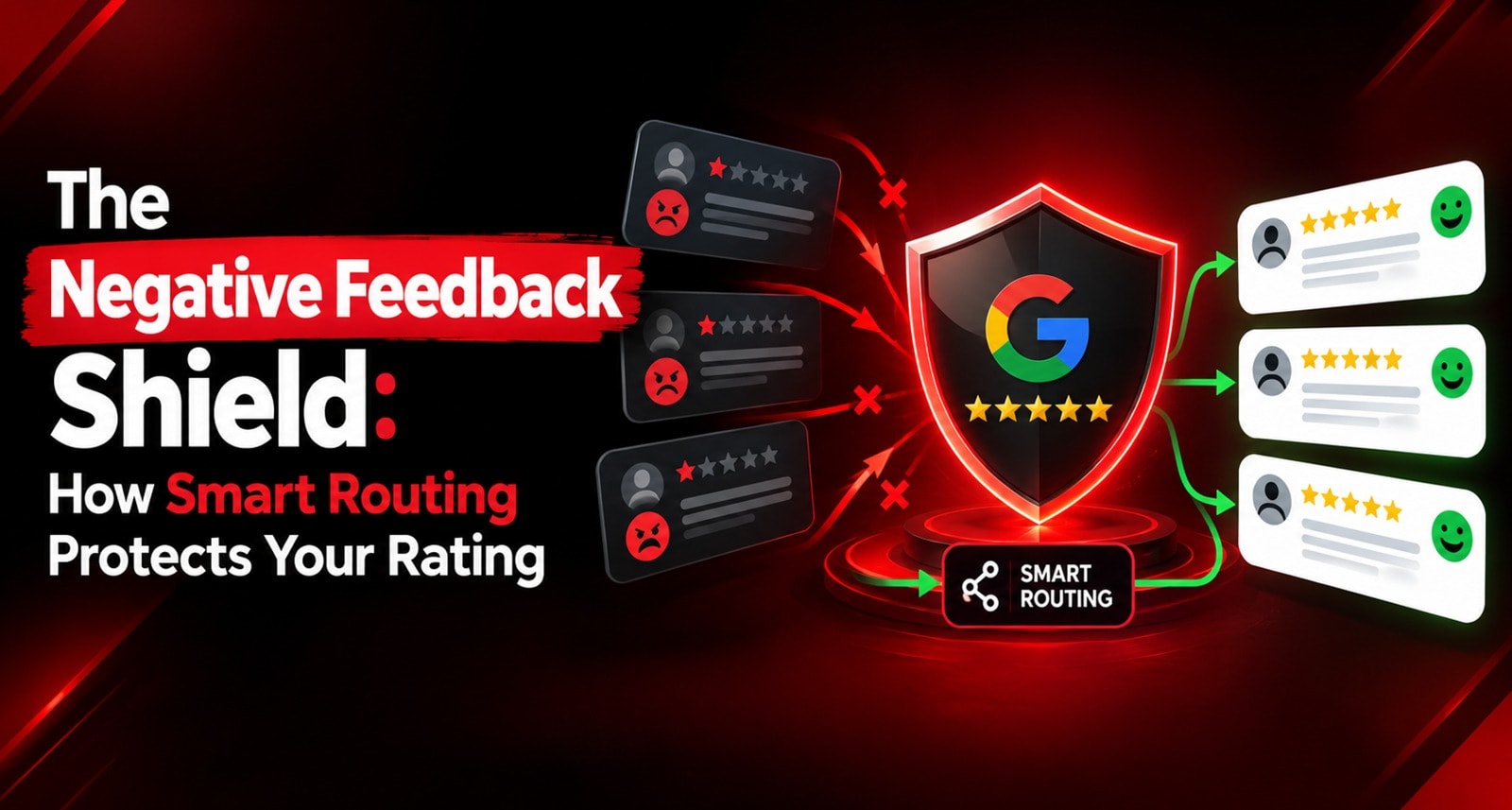
The Negative Feedback Shield is not a filter to hide bad reviews. It's a smart routing system that creates a fork in the road before the customer reaches Google.
It works on a simple principle: Give happy customers the fastest path to Google, and give unhappy customers the fastest path to you.
Think of it as a customer service triage:
If the customer is happy (3-5 Stars): They are guided to Google with an AI-assisted review draft they can post in one tap. This is how you get more customer reviews that are public, genuine, and powerful.
If the customer is unhappy (1-2 Stars): They are guided to a private feedback form. Their message comes to you instantly on your dashboard and WhatsApp. They do not land on your public Google page first.
⚠️ Compliance Point, Stated Plainly: This is service recovery, not suppression. No customer is ever blocked from posting on Google. Any customer can open Google Maps at any time and leave a public review if they choose to. Smart Routing simply offers a private channel first, giving you the opportunity to listen, apologize, and fix the problem while the customer is still with you. Handling and data policies are documented in our Privacy Policy and Terms & Conditions.
Where Reviews Actually Die: The 5 Drop-Off Points
Before we compare solutions, you need to understand why you fail to get more customer reviews even when customers are happy. There are five places where the review journey breaks:
Drop-off Point | What Kills It | How Paper QR Handles It | How Smart Routing Handles It |
1. Noticing | Prompt is invisible or faded | Fails in month 4 when ink fades | Branded NFC stand is always visible on counter |
2. Opening | Camera fumbling, bad light | 6-12 seconds with camera aiming | 2-3 second tap, no camera needed |
3. Landing | Wrong branch, dead link | Fixed link, becomes dead after rebrand | Cloud link, editable from dashboard forever |
4. Writing | Blank box = writer's block | Shows a blank box, customer quits | Shows tappable options + AI draft, zero writer's block |
5. Posting | Fear of public negative review | Sends angry customer to public Google | Routes angry customer to private form + alerts you |
Paper QR codes only solve point 1. The Negative Feedback Shield is engineered to survive all five. That is why it helps you get more customer reviews without the risk.
Here's Exactly What Happens: Step-by-Step
This is the complete journey when a customer taps your ReviewTAG NFC Card or scans the QR code on the same card:
Step 1: The Tap and The Fork
The customer taps or scans. Instead of going straight to Google, they land on a simple, branded screen: "How was your experience today?" with 1 to 5 stars. It takes one second and feels natural.
Step 2: The Intelligent Route
This is where the Shield activates.
If they tap ⭐⭐⭐, ⭐⭐⭐⭐ or ⭐⭐⭐⭐⭐, the system instantly opens your Google review box with a draft already written. The draft is based on the options they tapped - like "Excellent service, friendly staff, clean ambience." The customer just reads it, edits if they want, and hits Post.
If they tap ⭐⭐ or ⭐, they see a private form: "We're sorry to hear that. Tell us what went wrong so we can fix it." Their feedback is sent privately to you, not to Google.
Step 3: Instant Recovery
For a low rating, your manager gets an instant notification - often on WhatsApp within 5-10 seconds. You can walk over, apologize, and fix the issue while the customer is still in the store. The conversation that would have become a 1-star public review becomes a private service recovery.
Step 4: The Result
The happy customer's genuine review goes live on Google and helps you rank higher. The unhappy customer's issue is resolved privately, protecting your rating and often saving the customer relationship.
Round-by-Round Breakdown: Shield vs. Paper QR
Round 1: The Confidence to Ask
To get more customer reviews, your staff needs to ask everyone. With a paper QR, staff are scared to ask the person who looks annoyed. So they only ask customers they are 100% sure about - which means they ask 20% of customers.
With the Shield, staff know the unhappy customer will be routed privately. So they ask 100% of customers confidently. More asks is the single biggest lever to get more customer reviews.
Winner: Smart Routing. Confidence creates volume.
Round 2: Beating Writer's Block
This is where 60% of happy customers are lost. A paper QR sends them to a blank Google text box. It feels like homework. They type "Good service" and feel it's too short, so they close the tab.
Smart Routing never shows a blank box. It shows tappable chips - Service, Staff, Food, Cleanliness, Value - and then generates a natural, human-sounding review in a fraction of a second. The customer just verifies and posts. The full mechanics of this are detailed in our guide: How AI Writes a Genuine Google Review in a Fraction of a Second.
Winner: Smart Routing, by the widest margin.
Round 3: Negative Review Protection
Paper QR has no protection. It is actively working against you by inviting the angriest person to do the most public damage.
Smart Routing acts as your shield. The flow looks like this:
Rating Given | Paper QR Destination | Smart Routing Destination |
5 Stars | Google Blank Box | Google with AI Draft |
4 Stars | Google Blank Box | Google with AI Draft |
3 Stars | Google Blank Box | Google with AI Draft |
2 Stars | Google - Public | Private Form + Manager Alert |
1 Star | Google - Public | Private Form + Urgent WhatsApp Alert |
Winner: Smart Routing. Paper QR has no defence.
Round 4: Speed and Durability
A paper QR takes 6-12 seconds to open and fails in low light. It fades, tears, and gets destroyed by a spilled chai. Six months later, it silently stops working.
An NFC card opens in 2-3 seconds with a tap, works in the dark, and is made of durable PVC/acrylic that wipes clean. Even if the NFC chip ever fails, the printed QR on the same card continues to work. There is no single point of failure.
Winner: Smart Routing Card.
Round 5: Data and Improvement
If you want to get more customer reviews consistently, you need to know what's happening.
Paper QR gives you one number: your total review count on Google.
The Shield's dashboard gives you: Scans per day, Completions vs. Abandonment, Rating distribution, Private feedback trends, Performance per location, per table, and per shift.
You discover things like "The evening shift at Branch 2 gets 3x more private complaints about wait time" - and you can fix operations before it costs you your rating.
Winner: Smart Routing.
The Real Cost of One 1-Star Review
Businesses often think paper is cheaper. Let's do the math for why the Shield is an investment to get more customer reviews and protect revenue.
A Harvard Business Review study found that a one-star increase on Google can increase revenue by 5-9%. Conversely, a drop from 4.8 to 4.3 can push you below competitors in Google Maps "Top 3" results, where 70% of clicks happen.
One public 1-star review needs 10 new 5-star reviews to recover your average. If you get more customer reviews at a rate of 5 per month with paper, it will take you two months to recover from one night's angry customer. With the Shield, that 1-star never becomes public in the first place.
The hardware costs from ₹99, but the private feedback it captures is worth thousands in saved reputation.
Decision Matrix: Who Needs The Shield Most?
Business Type | Recommended Setup | Why The Shield Matters Most |
Restaurant / Café | NFC Table Tents + Shield + Printed Bill QR | High volume, one bad review during rush hour kills rating |
Dental / Medical Clinic | NFC Acrylic Stand at Reception | Low volume, high trust - one 1-star review scares 10 patients |
Salon / Spa | NFC Card handed at payment | Peak-emotion moment, expectation is very personal |
Retail Store | NFC Stand at Billing Counter | Staff can ask fearlessly even in a long queue |
Hotel | NFC Desk Puck at Checkout | Structured exit interaction, high review value |
Auto Workshop | NFC Card at Vehicle Handover | Single high-emotion handover moment |
Delivery / Cloud Kitchen | Printed Insert - Shield not ideal | No physical face-to-face moment to recover |
How to Activate Your Shield in 7 Days
You don't need to replace anything on day one. Run a hybrid system:
Day 1-2: Baseline
Note your current Google review count and rating. Without this, you won't know what worked.
Day 3: Setup
Connect your Google Business Profile to ReviewTAG, configure your questionnaire options, and enable Smart Routing from the dashboard.
Day 4-5: Place Strategically
Place NFC cards with Shield enabled at your 2-3 highest-traffic points only - billing counter, reception, exit. Leave your existing paper QRs where they are.
Day 6-30: Run Both
Watch your dashboard. You will see happy customers completing Google reviews and unhappy customers leaving private feedback. Track which table or location performs best.
Ongoing: Brief Staff
One sentence doubles results: "If you enjoyed your experience, just tap your phone here - it will take 5 seconds." The card removes friction; the human creates the prompt.
This hybrid approach is how you get more customer reviews fastest - durable NFC shields where it matters most, and paper where paper travels further like bills and packaging, all pointing to one cloud-managed link.
Conclusion
The goal is not to avoid negative feedback. Negative feedback is gold - it tells you what to fix.
The goal is to hear that feedback privately first, so you can fix it, instead of hearing it publicly when it's already too late.
A paper QR forces you to choose between trying to get more customer reviews and protecting your rating. The Negative Feedback Shield lets you do both. It gives happy customers the easiest path to praise you on Google, and it gives unhappy customers the fastest path to be heard by you.
That's not review gating. That's good service.
Ready to get more customer reviews without the fear of asking?
Explore the ReviewTAG Collection with Smart Routing →
Talk to Our Team on WhatsApp for a Free Setup Demo
Frequently Asked Questions [FAQ]
1. Is smart routing / rating-based filtering allowed by Google? Will it get me penalized?
When used correctly for service recovery, yes. Google's policy prohibits gating - which means selectively soliciting only positive reviews or preventing customers from leaving negative reviews. ReviewTAG does not block anyone from posting on Google. Any customer can still search for you on Google Maps and leave any review they want. The Shield simply offers a private feedback option first. It is a support channel, not a suppression wall.
2. Will this really help me get more customer reviews or will I get fewer?
You will get significantly more. Our merchants typically see 2-3x more Google reviews after enabling the Shield. This happens for two reasons: Staff ask every customer without fear, and the AI-assisted draft removes writer's block for happy customers, increasing completion rates from ~15% with paper QR to over 60%.
3. What happens to the private feedback from unhappy customers?
It is never posted to Google. It is sent privately to your ReviewTAG dashboard and instantly alerts your manager via WhatsApp/Email. Only you and your team can see it. You can reply, call the customer, and log the resolution.
4. Can a customer who gave me 1 star still go and post a public 1-star review on Google?
Yes, absolutely. We never prevent this. The private form is presented as a choice to be heard faster. If the customer still wants to post publicly after or instead, they are free to do so. In practice, most customers who feel instantly heard choose to give you a chance to fix it first.
5. Do I need a different card or QR for the Shield to work?
No. Every ReviewTAG NFC Card, Table Stand, and QR Sticker is powered by the same cloud platform. Smart Routing is a software feature you enable with one click in your dashboard. You can turn it on, off, or adjust the rating threshold anytime without reprinting anything.
6. Do my customers need to download an app?
No. The entire flow - from tap/scan, to rating, to AI draft, to private form - happens in their phone's browser. No app download, no signup is required for the customer.
About the author

Chandu Venkata Satish
Founder & Director
Chandu Venkata Satish is an entrepreneur, digital strategist and technology-driven business consultant with over ten years of experience working across digital strategy, political consulting, branding and technology. As the Founder of Technical Avengers, he leads the development of practical digital solutions that help businesses strengthen their online presence and accelerate growth. Review TAG is one such product, developed to simplify customer feedback and review generation through AI, QR and NFC technology, helping businesses turn genuine customer experiences into digital trust.
LinkedIn