The Question Everyone Actually Wants Answered
Let's not dance around it.
When a business owner hears "AI writes the review," the first thought is usually some version of: is this cheating?
It's a fair question, and it deserves a direct answer rather than marketing language. So here is the honest framing this entire article is built on:
AI writing a review for someone who never visited is fraud.
AI helping someone who did visit express what they already think is assistance.
The technology in both cases is similar. The inputs are completely different. And the inputs are what determine legitimacy — not the software.
Everything below explains what actually happens in that one second, so you can judge for yourself which side of the line a given system sits on.
Why Genuine Reviews Stopped Happening on Their Own
Before the mechanics, the problem.
Walk into any busy restaurant and ask the owner how many customers left happy today. They'll say most of them. Ask how many left a Google review. They'll say almost none.
That gap isn't dishonesty — it's friction. Specifically, four layers of it:
Friction layer | What the customer experiences |
Finding the listing | Typing the name, scrolling past similar businesses, picking the right branch |
The blank box | An empty text field that feels like homework |
Writer's block | "It was nice" feels too thin to submit |
Timing decay | By the time they remember, the feeling has faded |
The result is a systematic bias in who actually reviews you. Delighted customers rarely bother. Angry customers always do — because anger supplies the motivation that a blank text box otherwise demands.
So the average business's public rating isn't a representative sample of its customers. It's a sample of its most irritated ones, plus a handful of unusually diligent fans.
AI-assisted review drafting exists to correct that sampling bias — not to manufacture opinions, but to let the silent majority actually finish a sentence.
What the AI Actually Receives (The Inputs)
This is the part most articles skip, and it's the part that determines whether a review is genuine.
Before a single word is generated, the system collects real signals from a real person standing in your business:
1. The star rating
The customer taps a rating first. This isn't decorative — it sets the emotional register of the draft and, critically, determines the destination. A low rating never reaches a draft at all (covered further down).
2. Selected experience tags
The customer taps options describing what stood out: Service · Staff · Food · Ambience · Cleanliness · Quality · Wait time · Hospitality. These are configured by you per business type — a dental clinic's options look nothing like a café's.
3. Business context
Your business name, category, and the keyword set you configured in your dashboard. This is why a salon's drafts mention stylists and a workshop's mention turnaround time.
4. Optional free text
A short box where the customer can add anything in their own words — a staff member's name, a specific dish, a detail no preset option covers. This is the highest-value input, because it's unmistakably human.
5. Tone preference
Friendly, formal, casual, or detailed — configurable by the business, and sometimes selectable by the customer.
Notice what is not in that list: nothing is fabricated. Every input traces back to an action a real customer took in the last thirty seconds.
The test: If a system can generate a review with zero customer inputs, it's a fake review generator. If it produces nothing without them, it's an assistance tool.
The One Second, Broken Down
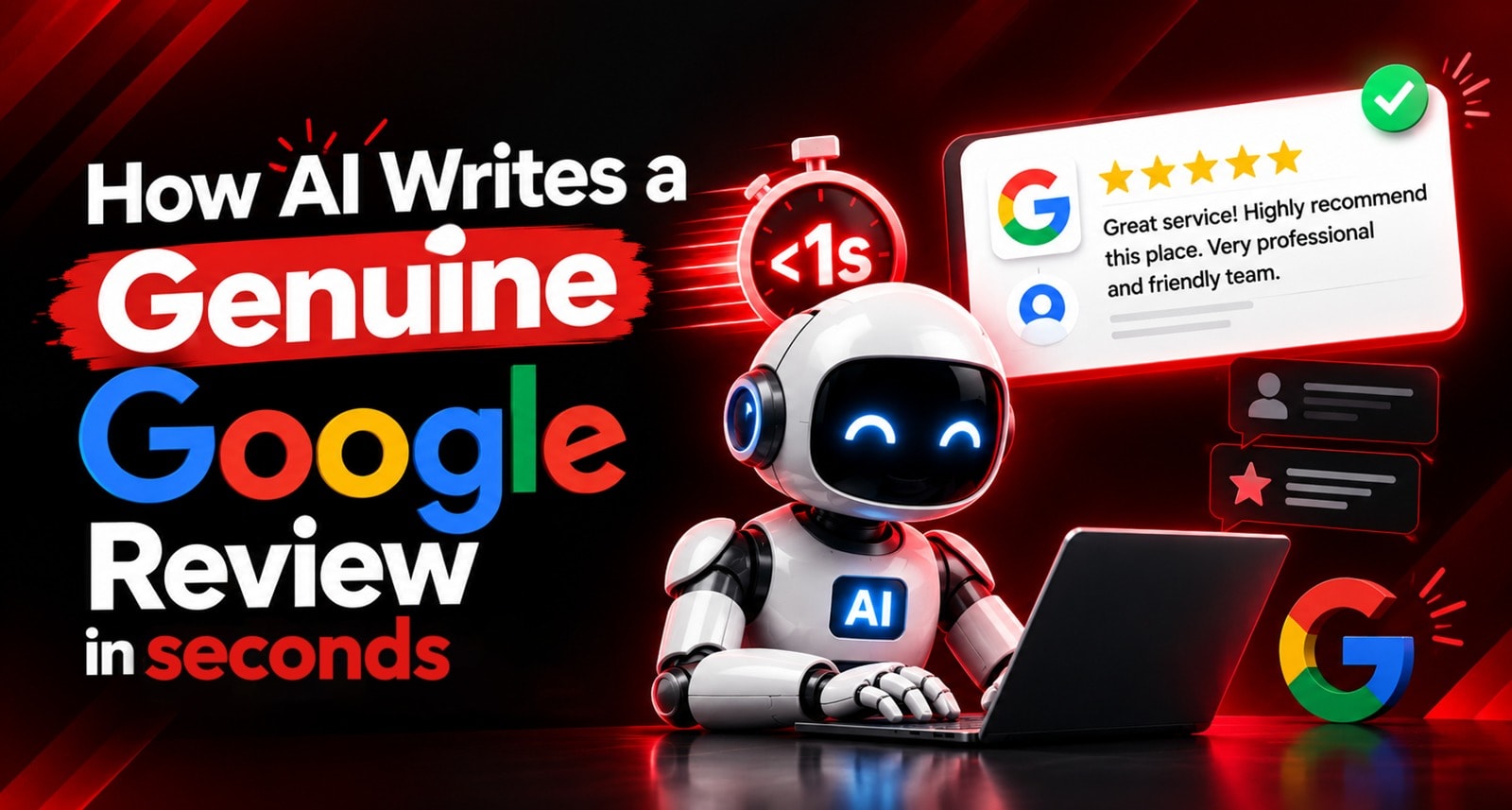
Here's what happens between the customer's last tap and the finished draft appearing on screen.
Millisecond 0–50: Input assembly
The system packages the rating, selected tags, business context, keyword configuration, tone setting, and any typed text into a single structured request.
Millisecond 50–150: Context conditioning
Your business-specific configuration is applied — category, vocabulary, language, and length preferences. A three-line review for a quick-service café is conditioned very differently from a four-sentence review for a dental clinic.
Millisecond 150–600: Language generation
The language model converts structured signals into natural sentences. It isn't retrieving a template from a library — it's constructing sentences probabilistically, which is why two customers who select identical options still receive noticeably different drafts.
Millisecond 600–800: Variation generation
Multiple drafts are produced in parallel with different structures and openings. This matters enormously for authenticity — identical reviews appearing across dozens of customers is the single clearest fingerprint of manipulation.
Millisecond 800–1000: Safety and coherence filtering
Drafts are checked for hallucinated specifics, exaggerated claims, and anything the customer didn't actually indicate. Clean drafts render on screen.
Then: the step that actually matters
The customer reads the options, picks one, edits it freely, and submits it from their own Google account. Nothing is posted automatically. Nothing is posted without them seeing it.
The AI's contribution took one second. The customer's contribution — the experience, the rating, the selections, the approval — took the entire visit.
Why AI Drafts Don't Read Like AI
A reasonable objection: won't these reviews sound robotic and identical?
They would, if the system used templates. Here's why well-built systems don't:
Design choice | Effect on authenticity |
Multiple variations per request | No two customers copy the same sentence |
Tone variation | Casual, warm, and formal drafts all appear |
Length variation | Some drafts are one line, some four |
Customer-specific inputs | Different tag combinations produce different content |
Free-text incorporation | Customer's own words carry into the draft |
Editing encouraged | Most customers tweak something |
Imperfect phrasing retained | Overly polished copy is the giveaway |
That last point is counterintuitive but important. A review reading "The establishment provided exemplary service across all dimensions" is obviously synthetic. A review reading "Food was really good, especially the biryani. Staff were quick even though it was crowded" reads human — because that's how people actually write.
Good systems aim for the second. The goal isn't the most impressive sentence. It's the most plausible one.
Where the Line Sits: Assisted vs. Fake
This is the section to bookmark, because it's where businesses get themselves into genuine trouble.
✅ Assisted Review (legitimate) | ❌ Fake Review (prohibited) | |
Did the customer visit? | Yes | No |
Who chose the rating? | Customer | Business or bot |
Who supplied the experience? | Customer | Fabricated |
Who approved the text? | Customer | Nobody |
Whose account posts it? | Customer's own | Fake or purchased |
Can it run without a customer? | No | Yes |
Google policy status | Permitted | Violation |
Google's review policies centre on one requirement: a review must reflect a genuine experience of the business. They do not require that the customer personally typed every word unaided. People have always had help — a friend suggesting a phrase, autocorrect, voice-to-text, predictive keyboards. Assistance in articulation has never been the issue.
What the policies prohibit is misrepresentation — reviews from people who weren't customers, fabricated experiences, incentivised ratings, and coordinated manipulation.
An AI drafting tool sits safely on the legitimate side only if every one of these holds:
✅ A real customer with a real experience initiates it
✅ The customer supplies the rating and the inputs
✅ The customer reads and can edit the draft
✅ The customer posts from their own account
✅ No incentive, discount, or gift is offered for a positive rating
✅ Nothing is generated or posted without the customer present
Remove any one of those and it stops being assistance. The compliance framing for this is set out in the ReviewTag Terms & Conditions and the Privacy Policy.
⚠️ One rule worth stating separately, because it trips up honest businesses: never offer a discount, free item, or entry into a draw in exchange for a review. This is an explicit policy violation regardless of whether AI is involved, and it's far more likely to get your listing penalised than any drafting tool.
What Happens to Unhappy Customers
A question that follows naturally: if AI drafts positive reviews, what about negative experiences?
They never reach the drafting step.
The rating is collected first, and it acts as a fork:
Customer rating | What happens |
⭐⭐⭐⭐⭐ / ⭐⭐⭐/ ⭐⭐⭐⭐ | AI drafts review options → customer posts to Google |
⭐⭐ / ⭐ | Google link not shown → private feedback form opens → manager alerted |
The dissatisfied customer gets a form asking what went wrong and how to reach them. That lands in your dashboard, often with an instant WhatsApp alert, giving you a chance to respond while they're still on the premises.
To be clear about what this is and isn't: nobody is prevented from posting publicly. Any customer can open Google independently and say whatever they want — and they should retain that right absolutely. What routing changes is who hears about the problem first. A complaint you resolve in five minutes is a customer retained. A complaint you discover three weeks later on your public profile is a customer lost and a rating damaged.
The mechanics of this routing are covered in What Is a Google Review Card and How Does It Actually Work?
What AI Is Actually Good At Here
Stripped of hype, the AI performs four narrow jobs — and it's worth naming them precisely, because overstating them is how vendors lose trust.
1. Removing the blank page. The single biggest cause of abandoned reviews. Solved entirely.
2. Translating tags into sentences. A customer taps Service, Ambience, Staff. Those three words become two readable sentences. That's a formatting task, not an opinion-forming one.
3. Keyword incorporation. Your configured terms — family dinner, pain-free treatment, same-day service — appear naturally when the customer's selections support them. These are the phrases Google associates with your listing for local search.
4. Language flexibility. A customer more comfortable in Hindi, Telugu, or Tamil can produce a fluent review in that language, or in English. Language barriers silently suppress a large volume of genuine reviews in Indian businesses.
What AI is not doing
❌ Deciding whether the customer was happy
❌ Creating experiences that didn't happen
❌ Posting on anyone's behalf
❌ Accessing anyone's Google account or password
❌ Guaranteeing any rating or outcome
Any vendor promising guaranteed five-star reviews is describing something other than an assistance tool.
Does Google Detect AI-Written Reviews?
Google's systems look for manipulation patterns, not prose style. The signals that actually trigger enforcement:
Signal | Risk level | Does assisted drafting trigger it? |
Reviews from accounts with no history | High | No — real customers, real accounts |
Sudden implausible volume spikes | High | Only if you deploy carelessly |
Identical or near-identical text | High | No — variation is built in |
Reviews from the same IP or device | High | No — customers use their own phones |
Geographic mismatch with the business | High | No — reviews happen on site |
Incentivised review language | High | Only if you offer incentives |
Natural, varied, customer-approved text | None | — |
Assisted drafting produces reviews from real accounts, on real devices, at real locations, with varied text, at an organic pace. That profile looks exactly like what it is: genuine customers reviewing a business they visited.
The pattern that does get businesses penalised is buying reviews in bulk from unrelated accounts — a completely different activity that some vendors unhelpfully bundle under the same "AI reviews" label.
Practical guidance: if you've had 40 reviews in three years, don't aim for 400 next month. Steady accumulation from genuine walk-ins is both safer and more credible to the humans reading your profile.
How to Keep Your Reviews Genuinely Genuine
Six operational rules. Most are about your behaviour, not the software's.
✅ Only prompt actual customers. Point of sale, after service, at check-out. Never a contact list.
✅ Never incentivise. No discounts, no freebies, no loyalty points for a review. This is the fastest route to a penalty.
✅ Let unhappy customers be unhappy. If someone insists on posting publicly, that's their right. Routing is for speed of response, not suppression.
✅ Keep the edit step visible. Customers who tweak a draft produce better, more varied, more credible reviews.
✅ Vary your keyword configuration. Rotate terms quarterly so drafts don't converge on the same vocabulary.
✅ Let the pace be natural. Reviews accumulating steadily over months always outperform a suspicious burst — with both Google and with the humans deciding where to eat tonight.
Explore the ReviewTAG Collection with Dynamic QR Codes →
Create Your ReviewTAG Business Account — Sign Up Now →
Talk to Our Team on WhatsApp for a Free Setup Demo
FAQs
Is it legal to use AI to write a Google review?
Yes, provided the review reflects a genuine experience of a real customer who reviews and approves the content before posting. What's prohibited is fabricating experiences or posting from accounts belonging to non-customers.
Will the customer know AI helped?
Yes — entirely transparently. They see the drafts, choose one, and can edit freely. Nothing is hidden or auto-submitted.
Can the customer write their own review instead?
Always. The draft is a starting point, not a requirement. Many customers rewrite it substantially, which is a good outcome.
Does the system need the customer's Google password?
No, and no legitimate platform ever should. The customer posts through their own already-signed-in Google account. If a vendor asks for Google credentials, stop immediately.
Can AI write reviews in Indian languages?
Yes — drafts can be generated in multiple languages, which meaningfully widens the pool of customers willing to leave a review.
What stops a business from generating reviews itself?
Ethics, Google's policies, and the fact that self-generated reviews produce exactly the device, IP, and timing patterns that detection systems are built to catch. The tool doesn't prevent misuse any more than a camera prevents bad photography — but misuse carries real consequences.
More answers are on the ReviewTag FAQ page.
About the author

Chandu Venkata Satish
Founder & Director
Chandu Venkata Satish is an entrepreneur, digital strategist and technology-driven business consultant with over ten years of experience working across digital strategy, political consulting, branding and technology. As the Founder of Technical Avengers, he leads the development of practical digital solutions that help businesses strengthen their online presence and accelerate growth. Review TAG is one such product, developed to simplify customer feedback and review generation through AI, QR and NFC technology, helping businesses turn genuine customer experiences into digital trust.
LinkedIn