First, Let's Be Honest About What's Being Compared
A lot of comparison articles rig this fight. They compare a smart NFC platform against a printed sticker and declare the platform better — which is like comparing a car to a bicycle and concluding the car is faster.
So let's define both fairly:
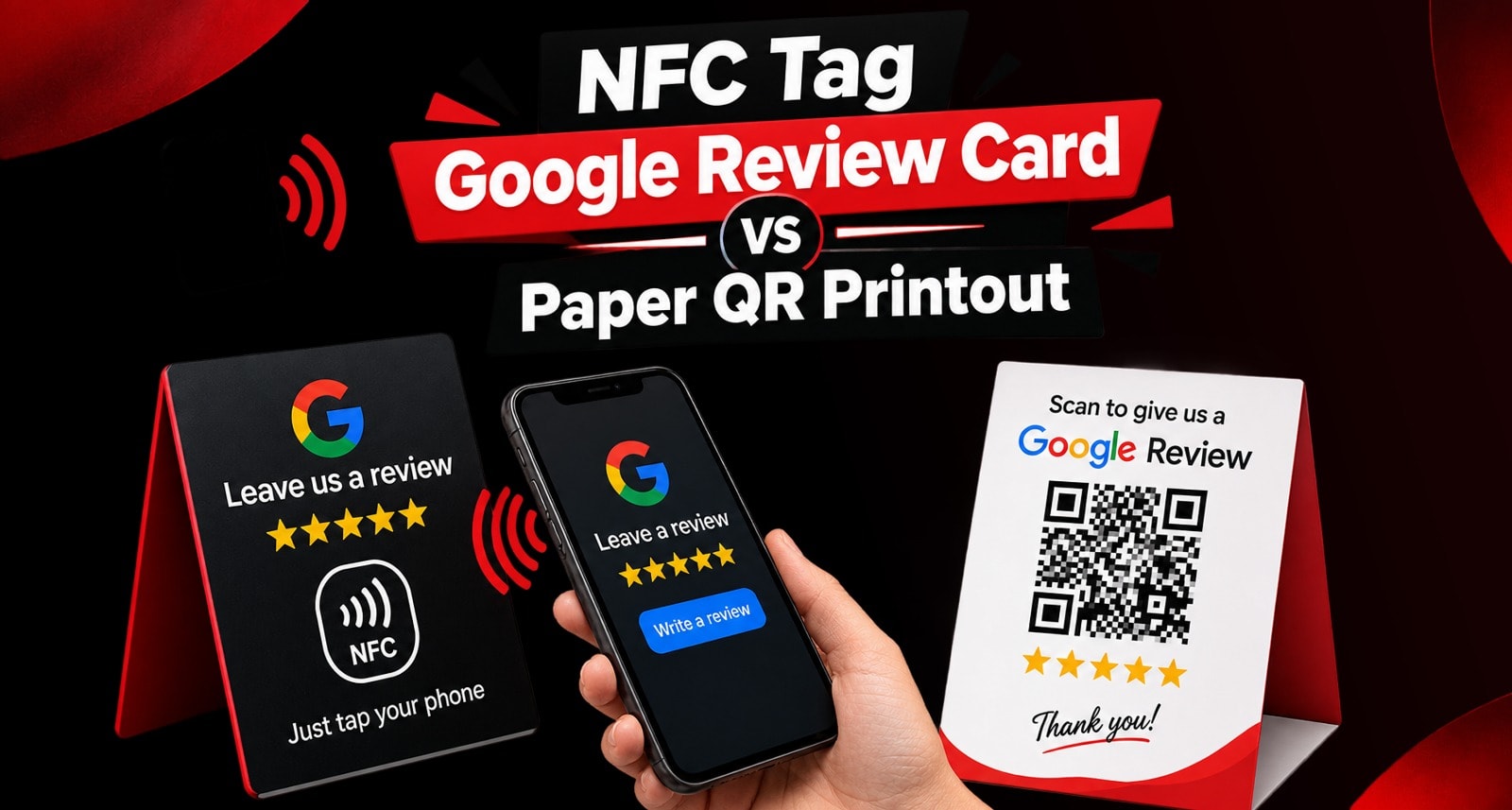
Paper QR Printout — a QR code printed on paper, sticker, or laminated card. Scan it, and Google's review box for your business opens. That's it. No dashboard. No filtering. No analytics. Cost: near zero.
NFC Google Review Card — a durable PVC, acrylic, or metal card carrying both an NFC chip and a printed QR code. Tap or scan, and a guided review experience opens — questionnaire, AI-assisted draft, rating fork, and a routed destination you control from a dashboard. Cost: hardware plus a software subscription.
Both aim at the same outcome: more Google reviews. They just leak customers at very different rates.
The Customer Journey Is Where Reviews Get Lost
Before comparing hardware, understand where review attempts actually die. There are five drop-off points between a happy customer and a published review:
Drop-off point | What kills it |
1. Noticing | The prompt is invisible, faded, or behind the counter |
2. Opening | Camera fumbling, bad lighting, damaged code |
3. Landing | Wrong listing, wrong branch, dead link |
4. Writing | Blank text box, writer's block |
5. Posting | Frustration, distraction, "I'll do it later" |
Paper QR handles point 1 adequately and fails at points 2, 3, 4, and 5. An NFC review card is engineered specifically to survive all five.
That's the whole argument in one table. Everything below is evidence.
Round 1: Speed — How Fast Does the Review Page Open?
Paper QR: Unlock phone → open camera app → aim → hold steady → wait for detection → tap the notification banner → wait for page load. Realistically 6–12 seconds, longer in dim restaurant lighting or if the customer's camera defaults to selfie mode.
NFC Card: Unlock phone → tap the card → tap the notification. Roughly 2–3 seconds. No camera, no aiming, no lighting dependency.
Those extra seconds sound trivial on paper. At a billing counter with a queue behind them, they aren't. The customer who fumbles for eight seconds looks up, notices people waiting, says "I'll do it at home," and never does.
Winner: NFC card — and the margin widens in low light, crowded spaces, and with older customers.
Note: A good NFC card still carries a QR code. The customer chooses. That's not a compromise — it's coverage.
Round 2: Durability — What Does It Look Like in Month Six?
This is the round nobody thinks about at purchase time, and everybody experiences at month four.
Condition | Paper QR | NFC Card |
Spilled chai / water | Destroyed | Wipes clean |
Daily handling | Creases, tears | Intact |
Sunlight on a counter | Ink fades, scan fails | Unaffected |
Kitchen grease | Smudged, unreadable | Wipes clean |
Being handed to 200 customers | Dog-eared by week two | Designed for it |
A faded QR code doesn't announce that it's broken. It just silently stops working while you assume the campaign is running. Businesses often discover this months later, after wondering why review flow dried up.
Winner: NFC card, decisively. Durability is the invisible cost of paper.
Round 3: The Blank Box — Where Most Reviews Actually Die
Here's the failure mode nobody talks about.
A paper QR does its job perfectly: it opens Google's review page. And then Google presents an empty text field.
To your customer, that empty field reads as homework. They think for a moment, type "Good service", feel embarrassed by how thin it looks, and close the tab. Or they type nothing at all.
This isn't a scanning problem. The QR worked. The customer arrived. They still didn't review.
An NFC review card intercepts this exact moment. Instead of a blank field, the customer sees tappable options describing their experience — service, staff, food, ambience, cleanliness, wait time — configured by you. Those selections feed an AI that drafts a natural review in seconds. The customer reads it, edits if they want, posts.
The blank page never appears.
This is the single largest gap between the two options, and it's entirely invisible in a spec sheet comparison. You can read the full mechanics in What Is a Google Review Card and How Does It Actually Work? — the AI-drafting step is covered in detail there.
Winner: NFC card, by the widest margin of any round.
Round 4: Negative Review Exposure
Paper QR has no fork in the road. Every customer who scans it — delighted, indifferent, or furious — lands on the same public Google review box.
That means your printed QR code is actively inviting the angry customer to post publicly. You've handed a megaphone to the one person you least want holding one.
A smart NFC review card asks for a rating before revealing the destination:
Rating | Paper QR | NFC Card |
⭐⭐⭐⭐⭐ | → Google (blank box) | → Google (AI-drafted review) |
⭐⭐⭐⭐ | → Google (blank box) | → Google (AI-drafted review) |
⭐⭐⭐ | → Google (blank box) | → Google (AI-drafted review) |
⭐⭐ | → Google, publicly | → Private feedback form |
⭐ | → Google, publicly | → Private form + manager alert |
The low-rating customer gets a private feedback form, and your manager gets notified — often on WhatsApp within seconds. You get a chance to call, apologise, and fix it while the customer is still in the building.
⚠️ Compliance point, stated plainly: This is service recovery, not suppression. Nobody is blocked from posting publicly — any customer can open Google independently at any time. What routing does is give you the first opportunity to respond. Handling and data policies are documented in the Privacy Policy and Terms & Conditions.
Winner: NFC card. Paper QR has no defence mechanism whatsoever.
Round 5: What Happens When Your Link Changes?
This round decides the long game.
A printed QR code encodes a fixed URL. It is permanent. Which is fine — until:
You open a second branch and need a separate listing
Your Google Place ID changes after a profile merge or edit
You rebrand or change your business name
You move locations
Google changes its review URL structure
You want a different destination for a specific campaign
Every one of those events turns your entire printed stock into landfill. Reprint, redesign, redistribute, re-place. Every card, every table, every counter.
An NFC review card points to a cloud-hosted link you control. The chip stores a short URL; the destination behind it is editable from your dashboard. Change your Google listing, update one field, and every card you've ever distributed — including ones already in customers' hands — redirects correctly.
Scenario | Paper QR | NFC Card |
New branch opens | Reprint | Generate new code in dashboard |
Google Place ID changes | Reprint everything | Update one field |
Rebrand | Reprint everything | Update design only when convenient |
Seasonal campaign link | Reprint | Remap temporarily |
Round 6: Data — Do You Know If It's Working?
Paper QR: You know your total Google review count. That's the entire dataset. You can't tell which table performs, which branch is lagging, which shift collects reviews, or how many people scanned and abandoned.
NFC Card platform: Scans, completions, ratings distribution, private feedback volume, trend lines, per-location and per-code breakdowns, downloadable reports.
That last part matters more than it sounds. Without data, improvement is guesswork. With per-code tracking, you discover things like "Table 4 near the window outperforms every other table" or "the evening shift collects three times more reviews than the morning shift" — and then you act on it.
Winner: NFC card.
Round 7: Perception — What Does the Customer Think of You?
Small, but real. A laminated A5 printout taped to a counter reads as improvised. A branded acrylic stand or a weighted desk puck reads as an established business that invests in its experience.
The tap gesture itself carries a small novelty effect — customers often comment on it, which staff can use as a natural conversation opener. A paper QR generates zero conversation.
Winner: NFC card, on a soft but not worthless criterion.
Round 8: Cost — The Round Paper Actually Wins
Let's be fair. Paper is genuinely cheaper on day one.
Cost element | Paper QR | NFC Review Card |
Per-unit hardware | Pennies | From ₹99 per card |
Software subscription | ₹0 | Annual plan |
Design | DIY or free | Included with most vendors |
Replacement cycle | Every 2–4 months | Years |
Reprint on link change | Full reprint | ₹0 |
If your entire budget for this is zero, paper QR is not a stupid choice. It is meaningfully better than doing nothing, and doing nothing is the actual default for most businesses.
But run the twelve-month math honestly. Paper reprinted every quarter, plus staff time, plus a full reprint when something changes, plus the reviews lost to blank boxes and faded ink — the gap narrows fast. And the reviews you didn't collect don't show up on any invoice.
Current hardware and subscription pricing is listed on the ReviewTag.
Winner: Paper QR on day one. NFC card by month six.
The Scorecard
Round | Paper QR | NFC Review Card |
Speed to open | ❌ | ✅ |
Durability | ❌ | ✅ |
Beating writer's block | ❌ | ✅ |
Negative review protection | ❌ | ✅ |
Link flexibility | ❌ | ✅ |
Analytics & tracking | ❌ | ✅ |
Brand perception | ❌ | ✅ |
Day-one cost | ✅ | ❌ |
Works on every phone | ✅ | ✅ (via QR) |
Instant bulk distribution | ✅ | ⚠️ Shipping time |
Final: 8–2 in favour of the NFC review card.
Where Paper QR Still Genuinely Makes Sense
Not everything should be NFC. Paper wins in specific situations:
✅ Printed on the bill or receipt — the customer takes it home; NFC can't travel that way.
✅ Menus and packaging — a printed code on a pizza box or takeaway bag reaches customers you never physically meet.
✅ Event and pop-up stalls — a three-day exhibition doesn't justify durable hardware.
✅ Massive table counts on a tight budget — 120 tables tomorrow morning, near-zero budget.
✅ Delivery inserts — a small printed card inside the parcel.
The practical answer for most restaurants and retail businesses is both: durable NFC cards at every high-value touchpoint — billing counter, reception, key tables — and printed codes on bills, menus, and packaging, all pointing to the same cloud-managed link.
That hybrid setup is the actual best answer, and it's rarely offered because most vendors sell only one of the two.
Decision Matrix by Business Type
Business | Recommended primary | Why |
Restaurant / café | NFC table tents + printed bill codes | High volume, both touchpoints matter |
Dental / medical clinic | NFC acrylic stand at reception | Low volume, high review value, needs negative filtering |
Salon / spa | NFC card handed at payment | Peak-emotion handover moment |
Retail store | NFC stand at billing counter | Queue-time capture |
Auto workshop | NFC card at vehicle handover | Single high-emotion moment |
Hotel | NFC desk puck at check-out | Structured exit interaction |
Delivery / cloud kitchen | Printed insert (paper wins here) | No physical counter exists |
Event stall | Printed QR standee | Temporary by definition |
The Migration Path (If You Already Use Paper QR)
You don't have to rip anything out. Sequence it:
Week 1 — Note your current Google review count. This is your baseline. Without it, you'll never know if the change worked.
Week 2 — Set up your account, connect your Google Business Profile, configure the questionnaire and keywords. Start from the ReviewTag signup page.
Week 3 — Place NFC cards at your two or three highest-traffic touchpoints only. Leave the paper QR codes exactly where they are.
Week 4–8 — Run both in parallel. Watch which touchpoints produce reviews in your dashboard.
Week 9 — Expand NFC to the winning locations. Keep paper only where it genuinely wins — bills, packaging, menus.
Ongoing — Brief your staff. One sentence at handover ("If you enjoyed it, just tap your phone here") roughly doubles what the hardware collects on its own. The card removes the friction; the human still creates the prompt.
FAQs
Do all phones support NFC?
Most modern smartphones do, but not all — which is exactly why a good review card carries a QR code on the same product. The customer uses whichever works for them. Nobody is ever blocked.
Can't I just use a free QR generator?
You can, and it will open your Google review page. What it won't do is help the customer write anything, protect you from public one-star reviews, survive a spill, track performance, or survive a change to your Google link.
Does the NFC card need an app?
No. Tapping opens a web page in the phone's browser. No download, no install, no signup for the customer.
Is the NFC chip storing my customer's data?
No. The chip stores a short URL and nothing else. Data handling is documented in the Privacy Policy.
Can I have different codes for different branches or tables?
Yes — generate separate codes per location, table, or campaign, and track each independently from the dashboard.
What if the NFC chip stops working?
The printed QR code on the same card continues to function. Dual-technology cards have no single point of failure.
More answers are available on the ReviewTag FAQ page.
Explore the ReviewTAG Collection with Dynamic QR Codes →
Create Your ReviewTAG Business Account — Sign Up Now →
Talk to Our Team on WhatsApp for a Free Setup Demo
Conclusion
A paper QR printout is better than nothing — genuinely. If the choice is between a printed code and no prompt at all, print the code today.
But understand what you're accepting. You're accepting that the code fades, that the link is permanent, that angry customers get a direct line to your public rating, that you'll never know which placement works, and that most people who scan it will stare at a blank box and close the tab.
An NFC Google review card costs more because it solves those five problems instead of just the first one. It removes the camera step, survives the year, drafts the review, shields the profile, and stays re-pointable forever.
The honest recommendation: durable NFC cards at the moments that matter most, printed QR codes wherever paper travels further, and both pointing at one cloud-managed link you control.
That's not a compromise. That's coverage.
👉 Explore the ReviewTag collection or message the setup team on WhatsApp for a free custom-design quote.
About the author

Chandu Venkata Satish
Founder & Director
Chandu Venkata Satish is an entrepreneur, digital strategist and technology-driven business consultant with over ten years of experience working across digital strategy, political consulting, branding and technology. As the Founder of Technical Avengers, he leads the development of practical digital solutions that help businesses strengthen their online presence and accelerate growth. Review TAG is one such product, developed to simplify customer feedback and review generation through AI, QR and NFC technology, helping businesses turn genuine customer experiences into digital trust.
LinkedIn